Clearwater Lady Bird Deed Attorney

A Clearwater Lady Bird Deed, known formally as a Florida enhanced life estate deed, lets your home or condominium pass directly to the beneficiaries you name at your death, with no Pinellas County probate case on that property. Nothing changes while you are alive: you stay on title, you keep your homestead exemption, and you can rent, refinance, sell or revoke the deed entirely.

Clearwater is an older, settled, largely owner-occupied city. 16.9% of residents are 65 or older, 58.6% of housing is owner-occupied, the median owner-occupied home is worth $361,300, and median household income is $66,381. That is a place where many people are house-rich and cash-modest, the profile a reverse mortgage is built for.

So this page answers a question the other city pages on this site do not. What happens to a Lady Bird Deed when the house it covers secures a reverse mortgage? The deed still works and is still worth doing, and it does not stop the loan coming due. Your family inherits a house and a clock at once, and if nobody tells them the clock exists, the deed will have worked while the family is still in trouble.

Clearwater Lady Bird Deed: the short version

  • What it does: names beneficiaries who receive the property automatically at death, outside of probate.
  • What you keep: full control for life, with freedom to sell, rent, refinance or revoke without anyone's permission.
  • A reverse mortgage survives the deed. A Home Equity Conversion Mortgage becomes due and payable when the last surviving borrower dies or permanently leaves the home.
  • Heirs inherit a timeline. HUD guidance states the loan must be satisfied within 30 days of the borrower's death, with 90-day extensions possible where the estate documents active efforts to sell or repay.
  • The deed still helps, because it removes the probate case that would otherwise run in parallel with that timeline.
  • Selling during life is often better, and the enhanced reservation keeps that option open.
  • Where it records: the Pinellas County Clerk of the Circuit Court & Comptroller, local counter at 14250 49th Street North.

What Is a Clearwater Lady Bird Deed?

A Clearwater Lady Bird Deed is the common name for a Florida enhanced life estate deed recorded on property in Pinellas County. It names the beneficiaries, called remaindermen, who receive the property automatically at your death, while reserving to you an enhanced life estate that leaves you in control while you are alive.

The enhancement is the point. Under a traditional life estate deed you could not sell without every named beneficiary signing, which turns a decision about your own house into a negotiation with your children. An enhanced life estate deed reserves the power to sell, convey, mortgage, lease and revoke without their consent. On a property carrying a reverse mortgage, that reserved power is what lets you deal with the loan yourself.

The recording formalities come from Fla. Stat. §§ 689.01 and 695.03. The enhanced reservation itself is a creature of Florida practice and title custom rather than a statute written for it, which is why drafting matters. For a broader comparison, see our guide to Lady Bird Deeds versus wills, trusts and quitclaim deeds.

Clearwater Lady Bird Deed attorney helping Pinellas County homeowners avoid probate

Reverse Mortgages: What the Deed Does Not Fix

The federally insured reverse mortgage is called a Home Equity Conversion Mortgage, or HECM. It lets an older homeowner draw on the equity without making monthly principal and interest payments, so the balance grows instead of shrinking. In a city with Clearwater's age and ownership profile that is not unusual. What is unusual is a family that understood the ending before it arrived.

Here is the fact that governs everything else on this page. A HECM becomes due and payable when the last surviving borrower dies or permanently leaves the home. Death is a maturity event. So is a permanent move, usually into a care facility that turns out not to be temporary. The loan does not carry on quietly while the family decides. It matures.

Now put a Lady Bird Deed next to that. The deed determines who owns the house, and that ownership passes without a probate case. It does not determine what is owed on it. A recorded mortgage is a lien against the property and does not care how title moves. Your daughter takes title subject to a loan that has already matured.

What a Lady Bird Deed does and does not do to a reverse mortgage

  • Does: move title to your beneficiaries at death, with no probate case on that property.
  • Does: leave you free during life to sell and pay the loan off yourself.
  • Does not: stop the loan becoming due and payable at the death of the last surviving borrower.
  • Does not: reduce the balance, extend the deadline, or bind the servicer to anything.
  • Does not: excuse the estate from taxes and insurance while the house sits unsold.

People sometimes conclude the deed is pointless where there is a reverse mortgage. It is not, for reasons set out in why the deed still matters below. But the right conclusion is almost as important: a deed alone is not a plan for a house with a HECM on it. The deed is the first half. Telling your family in advance, in writing, that a deadline exists and who to call, is the second.

Sources: U.S. Department of Housing and Urban Development, guidance on inheriting a home secured by an FHA-insured Home Equity Conversion Mortgage; 24 C.F.R. Part 206. Individual loan documents and servicer requirements govern. Confirm the position on a particular loan with the servicer.

The Clock Your Heirs Inherit

HUD's guidance to heirs is direct. "The loan must be satisfied within 30 days of the date of the borrower's death." Thirty days, measured from the date of death: not from the date the family found out, and not from the date somebody finally opened the mail.

The rest of the rule helps. The lender may grant 90-day extensions where the estate shows active efforts to sell or repay, with satisfactory documentation. That is how most of these get resolved, because almost nobody markets and closes a house in a month. But notice the shape of it. An extension is something the lender may grant, conditioned on documented effort. It rewards a family that calls in week one with a listing agreement or a refinance application, and does nothing for one that goes quiet for three months.

What HUD guidance says heirs can do

  • Sell the home, or repay the loan balance to keep it. Those are the two routes, and the choice belongs to the heirs.
  • Where the balance exceeds the value: "the estate or heirs may sell the home for at least 95-percent of the current appraised value and the lender will accept the net proceeds as satisfaction of the loan." HECMs are non-recourse.
  • Property taxes and insurance remain the estate's responsibility until title transfers.
  • Non-borrowing spouses have separate rules and must provide certification to the lender within 30 days to potentially remain in the property.

Take the non-recourse point seriously, because fear of a shortfall drives the worst decisions. Families find a balance larger than the house is worth and assume they are personally on the hook. They are not. The 95 percent rule means a sale at or above ninety-five percent of current appraised value satisfies the loan out of net proceeds. The family loses an inheritance, not their own money.

The taxes and insurance point quietly costs people. A Clearwater house sitting empty through hurricane season, coverage lapsed because nobody kept paying and the carrier was never told the owner had died, is a risk carried on top of the deadline. That needs a phone call in the first week.

Sources: U.S. Department of Housing and Urban Development, guidance on inheriting a home secured by an FHA-insured Home Equity Conversion Mortgage; 24 C.F.R. Part 206. Individual loan documents and servicer requirements govern. Confirm the position on a particular loan with the servicer.

Why the Deed Still Matters Here

All of that could be read as an argument against bothering with a Lady Bird Deed here. It is the opposite, and the reason is what runs in parallel.

Picture the version without a deed. The owner dies, the loan matures that day, and the family has thirty days to satisfy it, with an extension only if somebody can document active effort. Meanwhile title is stuck. Nobody has authority to list the house, accept an offer, or convey it at closing. To get it, the family must open a probate case in Pinellas County, and court timelines were not designed around a servicer's calendar.

That is the worst possible combination: a maturity clock running while the people who need to act cannot yet act. The extension provision asks the estate to show active efforts to sell, and it is hard to show efforts to sell a house nobody has power to sell.

Now the version with the deed. The loan still matures and the thirty-day period still starts, but title has already moved. The beneficiaries own the property from the moment of death. They can call the servicer as owners, list the house, sign a contract, or apply for a refinance, and in week one produce exactly the documentation an extension depends on.

The deed does not remove the deadline. It removes the thing that would have made the deadline impossible to meet.

One related point. Florida's summary administration route under Fla. Stat. § 735.201 exists for smaller estates, and the non-exempt asset ceiling was raised to $150,000 effective July 1, 2026 by CS/SB 1500, for deaths on or after that date. It is still a path through a courthouse, and the house is usually the asset that decides which path an estate takes. Moving it out of the probate estate is what makes the rest small, or unnecessary.

Selling During Your Lifetime, Which Is Often the Better Answer

Here is the option that gets skipped, usually because nobody says it out loud in a planning meeting. If your house carries a reverse mortgage and you expect your children to sell it after you are gone, consider selling it yourself, on your own timetable.

The enhanced life estate reservation is what makes that possible. A properly drafted deed reserves your power to sell, convey, mortgage, lease and revoke without the consent of anyone you named, so recording a deed today never becomes a reason you cannot sell tomorrow. The deed and the sale are not alternatives. The deed is what keeps the sale available.

Compare the two versions. In one, you list in a season you chose and pay off the loan at a closing you attended. In the other, your children list in whatever month you happened to die, under a deadline, while handling a funeral, with the servicer asking for evidence of effort. Same house, same loan, often the same proceeds, a completely different experience.

None of this is a recommendation to sell. Plenty of Clearwater owners will stay put, and should. The point is narrower: a lifetime sale is on the menu, the deed keeps it there, and it deserves to be weighed rather than never raised.

The Non-Borrowing Spouse Problem

One situation deserves its own heading, because getting it wrong is the harshest outcome on this page: a married couple where only one of them is a borrower. That happens for ordinary reasons, including age requirements or a house owned before the marriage. The result is that the loan matures on the death of the last surviving borrower, and a spouse who was never a borrower is not the person who keeps it alive.

Non-borrowing spouses have separate rules and must provide certification to the lender within 30 days to potentially remain in the property. Every word carries weight. The rules are separate, so the answer is not the one heirs get. Somebody has to act, within thirty days, the tightest deadline in this subject. And the spouse may potentially remain, which is not a guarantee.

So answer this while both spouses are alive to ask. Call the servicer, ask what certification is required and where it goes, get the answer in writing, and keep it with the loan number somewhere the family can find it. Florida's constitutional homestead protections for a surviving spouse, in the homestead section below, are separate law and do not substitute for the loan requirements.

Clearwater Estate Planning Snapshot

An older, majority owner-occupied city with modest incomes relative to house values.

  • 16.9% of Clearwater residents are age 65+
  • 58.6% of housing units are owner-occupied
  • $361,300 median value of owner-occupied housing
  • $66,381 median household income
  • 17.2% of residents are foreign-born
  • 22.3% speak a language other than English at home

Read the first four together and the reverse mortgage picture explains itself. A median home value of $361,300 against a median household income of $66,381 describes a city where the house is worth several times what the household earns in a year. Add 16.9% aged 65 or older and 58.6% owner-occupied, and you have a large population of older owners holding most of their net worth in a building they live in.

The language figures matter differently. With 17.2% foreign-born and 22.3% speaking a language other than English at home, a dense English letter mailed to a house where the person who read the mail has just died is not a reliable way to learn about a deadline. Where the household's strongest English reader was the owner, writing the loan details down in advance matters more.

Demographic figures: U.S. Census Bureau QuickFacts, Clearwater city, Florida (most recent American Community Survey five-year estimates available at publication).

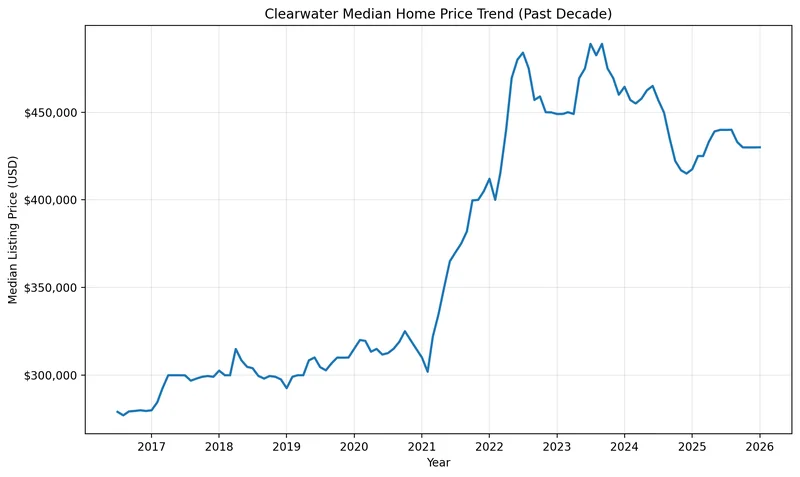
Chart of the Clearwater median home price trend over the past decade, used for Pinellas County estate planning and Clearwater Lady Bird Deed research
Clearwater median home price trend (past decade)
Where a reverse mortgage is involved, the value line and the growing loan balance are the two numbers a family eventually compares.

Two Tax Numbers That Move at Death

Separate from the loan, two tax mechanisms change at death, and families routinely mistake one for the other.

Two different taxes, two different mechanisms, opposite outcomes.
 Save Our Homes capStepped-up basis
Which tax?Florida property taxFederal income tax on a later sale
What happens at your death?Resets to market valueResets to market value
Good or bad for your family?Bad. The tax bill goes up.Good. The taxable gain shrinks or disappears.
Does the deed change it?No. Same through probate or a trust.The deed preserves it, where a lifetime gift would not.

The Save Our Homes cap resets on the change of ownership at death. Whatever gap had built up between assessed and market value stops with you, whether the property passes by Lady Bird Deed, through probate, or out of a trust. A beneficiary who moves in applies for their own exemption and starts their own cap.

The stepped-up basis runs the other way and is usually the more valuable of the two. Because the property remains in your gross estate, your beneficiaries' cost basis becomes the date-of-death value rather than what you paid. That is the strongest reason not to deed the house to your children as a probate shortcut: a gift gives up the step-up, while the Lady Bird Deed keeps it.

Homestead Exemption, Save Our Homes and Spousal Rights

A properly drafted Clearwater Lady Bird Deed should not disturb your homestead exemption or your Save Our Homes cap during your lifetime. You retain the enhanced life estate, you remain in possession, and the Pinellas County Property Appraiser continues to treat you as the owner of record.

It is worth separating the two homestead concepts, because they share a name and do different work. The homestead exemption is a property tax benefit administered by the Property Appraiser, and it is what Save Our Homes attaches to. The constitutional homestead under Art. X, § 4, Fla. Const. is a creditor protection and transfer restriction, applying whether or not you filed for the tax exemption.

On the constitutional side, a married owner cannot convey homestead without the spouse joining in the deed, whether or not the spouse appears on title, and homestead cannot be devised away from a surviving spouse or a minor child. These restrictions are tested at death rather than at signing, which is why a deed that looked fine for years can fail when it is needed. Where one spouse is a borrower and the other is not, this analysis and the loan certification both have to be satisfied.

Medicaid and Estate Recovery

Florida's Medicaid program is required by federal law to seek reimbursement from the estates of recipients aged 55 and over who received long-term care benefits, and the word doing the work is estate. Florida defines it narrowly: recovery reaches assets passing through the probate estate, and Florida has not adopted the expanded definition some states use.

Because a Lady Bird Deed moves the home outside probate, it is one of a standard tool for reducing estate recovery exposure on a Florida homestead. Recording it is not a transfer for the five-year look-back, because nothing leaves your control.

With 16.9% of Clearwater residents aged 65 or older, this is not a footnote. It also connects to the loan: the event that most often starts a long-term care conversation, a permanent move into a facility, is the same event that can make a HECM due and payable.

The limits

  • The deed does not qualify anyone for Medicaid. Eligibility is a separate analysis.
  • The five-year look-back applies to transfers of non-homestead assets.
  • Protection depends on the home keeping homestead status and passing to heirs; a will directing a sale undoes it.

Our full write-up is on the Florida Lady Bird Deed and Medicaid page.

Sources: 42 U.S.C. § 1396p; Fla. Stat. §§ 409.910 and 409.9101; Art. X, § 4, Fla. Const.

Recording a Clearwater Lady Bird Deed

Deeds in Pinellas County are recorded by the Pinellas County Clerk of the Circuit Court & Comptroller, in the county's Official Records. Recording counters operate at 14250 49th Street North, Clearwater and at 545 1st Avenue North, St. Petersburg, generally 8:30 a.m. to 4:30 p.m. weekdays. The Clerk's main office is at 315 Court Street, Clearwater. E-recording is available.

For a Clearwater owner the 49th Street North counter is the local one. It is also where the reverse mortgage was recorded: if you are not certain whether a property carries a HECM, the mortgage is public record in the same index as the deeds.

Execution requirements

Florida requires a deed conveying an interest in real property to be signed in the presence of two subscribing witnesses and acknowledged before a notary public (Fla. Stat. §§ 689.01 and 695.03). Both witnesses must be present and must sign. Deeds signed at a hospital or care facility without proper witnessing fail this test regularly, and the failure surfaces at death when it can no longer be corrected: a particularly bad failure where a loan deadline waits on the other side of the same death.

Recording fees and documentary stamp tax

Recording charges are $10.00 for the first page, $8.50 for each additional page, and $1.00 per name indexed beyond four names. The standard statewide documentary stamp rate is $0.70 per $100 of consideration on taxable deeds.

Whether the tax applies here was addressed in Technical Assistance Advisement 20B4-004 (October 16, 2020), in which the Florida Department of Revenue concluded that an enhanced life estate deed is not subject to documentary stamp tax, because no present beneficial interest transfers when the deed is signed. A Technical Assistance Advisement binds the Department only as to the taxpayer and facts presented. Where the property carries a mortgage, the analysis turns on whether there is consideration, so it is a question to look at rather than assume away.

Sources: Pinellas County Clerk of the Circuit Court & Comptroller, Recording (14250 49th Street North, Clearwater; 545 1st Avenue North, St. Petersburg; hours; e-recording; main office 315 Court Street, Clearwater); Florida Department of Revenue Technical Assistance Advisement 20B4-004 (Oct. 16, 2020); Fla. Stat. ch. 201; Fla. Stat. §§ 689.01, 695.03.

After a Death: What Your Family Actually Does

  1. Order certified death certificates

    From the Florida Department of Health. Order several: the Property Appraiser, the insurer, any association and the loan servicer will each want one.

  2. Call the loan servicer in the first days

    If there is a HECM this is the top of the list, because the satisfaction period runs from the date of death and any extension depends on documented effort.

  3. Record a death certificate against the property

    In the Pinellas County Official Records, establishing that the life estate has ended and the named beneficiaries hold title. Clear title quickly is what makes a sale or refinance possible.

  4. Keep taxes and insurance current

    They remain the estate's responsibility until title transfers, and a vacant house needs the carrier told rather than left to find out.

  5. Expect the property tax bill to change

    The property is reassessed at market value following the change of ownership, whether or not there was a deed.

What is not on that list, because of the deed: a petition, a filing fee, a personal representative, publication of notice to creditors, or a creditor claim period for that property. On a house with a maturing loan, that is the difference between acting in week one and waiting on a court.

What a Lady Bird Deed Does Not Do

Common misconceptions, the first being the reason this page exists.
People assume it…Reality
Stops a reverse mortgage coming dueNo. A HECM becomes due and payable when the last surviving borrower dies or permanently leaves the home.
Gives the heirs more time on the loanNo. The satisfaction period and any extension are set by HUD guidance and the servicer, not by how title passed.
Passes your Save Our Homes cap to the kidsNo. It resets on the change of ownership at death. No instrument prevents that.
Qualifies you for MedicaidNo. It may reduce estate recovery exposure on a homestead, but it does not create eligibility.
Stops you from sellingNo, and that is its strength. The reserved powers let you sell at any time without asking anyone.

How a Clearwater Lady Bird Deed Compares to the Alternatives

General comparison for a Florida homestead. No option stops a reverse mortgage maturing.
OptionAvoids probate?Stops a reverse mortgage coming due?Preserves stepped-up basis?Typical drawback here
Lady Bird DeedYes, for that propertyNoYesCovers only the property described in it.
Will onlyNoNoYesGuarantees a Pinellas probate case running alongside the loan deadline.
Revocable living trustYes, if fundedNoYesMore to set up, but better where you want to direct a sale.
Deed the home to the kids nowYesNoNoGives up the step-up and your own control at once.
Traditional life estate deedYesNoYesYou cannot sell to pay the loan off without every beneficiary signing.
Sell during your lifetimeNot applicableYes, it is repaid at your closingNot applicableYou have to move, which is the whole question.

Read the last row alongside the first. The deed and the lifetime sale are not competitors: the deed keeps the sale available at any moment, and the sale is the only option here that actually retires the loan on your own terms. Row four is what people reach for when they are trying to be helpful, and it loses the step-up and your control together. Our fuller breakdown is on the Florida Lady Bird Deed comparison page.

How to Get a Clearwater Lady Bird Deed

  1. Find out whether there is a reverse mortgage

    Check the recorded mortgage in the Official Records and the loan statements. If there is a HECM, everything else here is shaped by it.

  2. Confirm who the borrowers are, and who is not

    A spouse who is not on the loan is on a shorter track. Settle that with the servicer now, in writing.

  3. Confirm the deed fits your goals

    Title, beneficiaries, marital status, and whether there is a minor child.

  4. Pull the vesting deed and parcel number

    The exact legal description from the Official Records, plus the parcel identification number.

  5. Draft the enhanced life estate reservation

    Reserving your power to sell, convey, mortgage, lease and revoke without the beneficiaries' consent.

  6. Sign with two witnesses and a notary

    Both present and signing. A married owner's spouse joins the deed on homestead property.

  7. Record with the Pinellas County Clerk

    At 14250 49th Street North in Clearwater, at 545 1st Avenue North in St. Petersburg, or by e-recording.

  8. Write the loan details down for your family

    Servicer, loan number, phone number, and one line saying the loan becomes due at death.

START WITH A CONSULTATION

Plain-English Glossary

Enhanced life estate deedThe formal name for a Lady Bird Deed. You keep a life estate plus the power to sell, mortgage or revoke without anyone's consent.
HECMHome Equity Conversion Mortgage, the federally insured reverse mortgage. Due and payable when the last surviving borrower dies or permanently leaves the home.
Non-recourseThe lender looks to the property, not the family's own assets. Where the balance exceeds value, a sale for at least 95 percent of current appraised value satisfies the loan out of net proceeds.
Non-borrowing spouseA husband or wife who is not a borrower. Separate rules apply, including certification to the lender within 30 days.
Save Our HomesThe Florida cap on annual increases in assessed value of homestead property. It resets on the change of ownership at death.
RemaindermanA person named in the deed to receive the property at your death.
Stepped-up basisThe reset of cost basis to date-of-death value, which can eliminate accumulated capital gain on a later sale.
Summary administrationFlorida's shortened probate route under Fla. Stat. § 735.201. Non-exempt asset ceiling of $150,000 effective July 1, 2026 by CS/SB 1500, for deaths on or after that date.

Clearwater Neighborhoods We Serve

We prepare Lady Bird Deeds for property throughout Clearwater and Pinellas County, including:

  • Clearwater Beach
  • Island Estates
  • Sand Key
  • Countryside
  • Feather Sound
  • Morningside
  • Skycrest
  • Coachman Ridge
  • Del Oro Groves
  • Harbor Oaks
  • Belleair border
  • Dunedin border
  • Safety Harbor border
  • Largo border
  • Northwood Estates
  • Bayview
  • Mandalay
  • Downtown Clearwater
  • Chautauqua
  • US 19 corridor

Work With a Clearwater Lady Bird Deed Attorney

Yanitza Schoonover focuses on probate administration and estate planning for Florida families. She helps Clearwater homeowners with:

  • Clearwater Lady Bird Deed drafting, execution and recording
  • Planning for homes that secure a reverse mortgage
  • Formal and summary probate administration
  • Estate planning coordination for Florida homesteads


If there is a reverse mortgage on your house, the deed is worth doing and it is only half the job. The other half is making sure the people you named know the deadline exists before they are holding a letter from a servicer.

Schedule Your Consultation
Clearwater Lady Bird Deed attorney Yanitza Schoonover

Yanitza Schoonover

Clearwater Lady Bird Deed Frequently Asked Questions

My mother has a reverse mortgage. Does a Lady Bird Deed stop it becoming due?

No, and this is the point of the page. A Home Equity Conversion Mortgage becomes due and payable when the last surviving borrower dies or permanently leaves the home. The deed changes who holds title and removes the probate case, but it does not change the loan. Your heirs receive a house and a deadline together. The deed is still worth recording, because the alternative is that same deadline running while a probate case is pending, which is the worst combination available.

How long do the heirs actually have?

HUD guidance for heirs states that "The loan must be satisfied within 30 days of the date of the borrower's death." The lender may grant 90-day extensions where the estate shows active efforts to sell or repay, with satisfactory documentation. Extensions are not automatic: they depend on contacting the servicer promptly and producing a listing agreement, a purchase contract or a loan application. Individual loan documents and servicer requirements govern.

What if the loan balance is more than the house is worth?

A Home Equity Conversion Mortgage is non-recourse. Where the balance exceeds the value, "the estate or heirs may sell the home for at least 95-percent of the current appraised value and the lender will accept the net proceeds as satisfaction of the loan." The family is not chased for the shortfall out of their own money.

Can the heirs keep the house instead of selling it?

Yes. Heirs may either sell the home or repay the loan balance to keep it. Repaying usually means refinancing in the heir's own name, or paying cash. Time is the constraint, not willingness: an heir who wants to keep the house should be talking to a lender within days, because an underwriting calendar and a 30-day satisfaction period are not the same length.

Who pays the property taxes and insurance in the meantime?

Property taxes and insurance remain the estate's responsibility until title transfers. That does not pause because the family is grieving or the sale has not closed. A policy on a vacant Clearwater house needs attention too, since vacancy affects coverage under many policies.

My husband is not on the reverse mortgage. Can he stay in the house?

Possibly, but it is a specific process with a short fuse. Non-borrowing spouses have separate rules and must provide certification to the lender within 30 days to potentially remain in the property. The word potentially matters, and so does the deadline. If one spouse is a borrower and the other is not, find out now, in writing, what the servicer expects and by when.

Should we just sell the house during my lifetime instead?

It is often the better answer. A properly drafted Lady Bird Deed reserves your power to sell, convey, mortgage, lease and revoke without the beneficiaries' consent, so the deed never blocks a sale. Selling while you are alive lets you control the timing, the price and the repayment, rather than leaving it to a clock that starts on your family's worst day.

Where is a Lady Bird Deed recorded in Pinellas County?

With the Pinellas County Clerk of the Circuit Court & Comptroller, in the county's Official Records. Recording counters operate at 14250 49th Street North, Clearwater and at 545 1st Avenue North, St. Petersburg, generally 8:30 a.m. to 4:30 p.m. weekdays. The Clerk's main office is at 315 Court Street, Clearwater. E-recording is available. For a Clearwater owner the 49th Street North counter is the local one.

Does a Clearwater Lady Bird Deed protect the home from Medicaid estate recovery?

Florida limits Medicaid estate recovery to assets passing through the probate estate, and has not adopted the expanded definition some states use. Because a Lady Bird Deed moves the home outside probate, it is one of the standard tools for reducing exposure on a Florida homestead, and with 16.9% of Clearwater residents aged 65 or older it comes up often. The deed does not create eligibility, the five-year look-back applies to non-homestead transfers, and protection depends on the home passing to heirs. See our Medicaid guide.

Do my beneficiaries still get a stepped-up basis if there is a reverse mortgage?

The basis mechanism is not changed by the presence of a loan. Because the property remains in your gross estate, your beneficiaries' cost basis becomes the date-of-death value rather than what you paid. Where a reverse mortgage has consumed much of the equity there may be less gain to shelter, but the step-up still governs. The Save Our Homes cap resets at death. Confirm the treatment with a tax advisor.

More general questions are on our Florida Lady Bird Deed FAQ page.

We also assist homeowners across Florida including Saint Petersburg, Tampa, Orlando, Cape Coral, and Fort Lauderdale. Browse every market on our areas we serve page.

Florida Lady Bird Deed Attorney Serves Homeowners Across Florida

We help homeowners throughout Florida with Lady Bird Deeds and probate avoidance planning. Below are many of the primary Florida markets we serve, but we're not limited to these locations. You can also browse the full Florida Lady Bird Deed city and county directory.

Boca RatonBoynton BeachCape CoralClearwaterCoral SpringsDavieDaytona BeachDeerfield BeachDoralFort LauderdaleHallandale BeachHialeahHollywoodHomesteadJacksonvilleKendallLauderdale LakesMiamiMiami BeachMiramarOrlandoParklandPembroke PinesPine HillsPlantationPompano BeachPort Saint LucieSaint PetersburgSunriseTallahasseeTampaWest Palm BeachWeston

Legal disclaimer. This page is general information about Florida law, not legal advice, and reading it does not create an attorney-client relationship. Reverse mortgage requirements, deadlines and extension practices depend on the individual loan documents and the servicer, and must be confirmed with that servicer. Recording locations, fees, tax rates and court procedures described were accurate as of August 2026 and should be confirmed with the Pinellas County Clerk of the Circuit Court & Comptroller and the Florida Department of Revenue.

The Schoonover Law Firm, P.A. · Yanitza Schoonover, Attorney at Law · Licensed in Florida. Attorney advertising.