Sunrise Lady Bird Deed Attorney

A Sunrise Lady Bird Deed, known formally as a Florida enhanced life estate deed, lets your home or condominium pass directly to the beneficiaries you name at your death, with no Broward County probate case. Nothing changes while you are alive: you stay on title, you keep your homestead exemption, and you can live in the property, rent it, refinance it, sell it, or revoke the deed entirely.

Sunrise is one of Broward's most settled ownership markets: 68.8% of housing units are owner-occupied, 19.5% of residents are 65 or older, and the median owner-occupied value of $354,500 reflects a large stock of attainable single-family homes and long-established condominium communities.

It is also, like every American community, a place where marriages end and begin again. And Florida law handles that fact very unevenly depending on which document you are looking at.

When you divorce, Florida automatically strips your former spouse out of your will, your life insurance, your IRA and your payable-on-death accounts. Most people know this, or at least sense it. What almost nobody knows is that the same protection does not extend to a deed. Real property was left off the list.

Sunrise Lady Bird Deed: the short version

  • Divorce does not remove an ex-spouse from a deed. Fla. Stat. § 732.703 lists the assets it covers, and real property is not among them.
  • Only a new recorded deed fixes it. Not the divorce judgment, not a letter, not telling your children.
  • Remarriage cuts the other way. A new spouse gains constitutional homestead rights that an older deed may collide with.
  • Avoiding probate is not avoiding the elective share. Under § 732.2035, revocable transfers and protected homestead both count toward the elective estate.
  • Married couples: tenancy by the entireties means the deed usually operates at the second death, not the first.
  • Where it records: Broward County Records, Taxes & Treasury, not the Clerk of Courts.

What Is a Sunrise Lady Bird Deed?

A Lady Bird Deed is a deed you record now that takes effect only when you die. It splits your ownership in two. You keep an enhanced life estate: the right to live in the property for life, plus the reserved power to sell it, mortgage it, lease it, give it away or cancel the deed entirely, all without asking anyone. The people you name hold a remainder interest that is worth nothing and confers nothing until the day you die.

That reserved power is the whole design. Under a traditional life estate deed, the remaindermen own something the moment it is recorded: they have to consent to a sale, and their creditors and divorces attach to your home. Under a Lady Bird Deed none of that happens, because they own nothing you cannot take back.

When you die, the property is already theirs. No probate case, no petition, no personal representative. They record a certified death certificate against the parcel and the chain of title is complete.

The same feature that makes the deed powerful (that it is a recorded instrument taking effect automatically at death) is what makes it dangerous when your life changes and the deed does not. A deed does not know you got divorced.

Sunrise Lady Bird Deed document prepared by a Broward County estate planning attorney

Your Divorce Did Not Remove Your Ex-Spouse From the Deed

Florida has two automatic-revocation statutes, and between them they cover most of what an ordinary person owns. Both are good law. Neither one covers a deed.

What the statutes actually do

Fla. Stat. § 732.507(2) handles wills. On dissolution of marriage, the will is construed as if the former spouse had died at the time of the dissolution. Your ex is written out, automatically, with no action required from you.

Fla. Stat. § 732.703 handles beneficiary designations. It provides that a designation made by the decedent providing for the payment or transfer at death of an interest in an asset to or for the benefit of the decedent's former spouse is void as of the time the marriage was judicially dissolved, if the designation was made before the dissolution.

That sounds sweeping. Everything turns on the word asset, which the statute defines by an enumerated list.

Does a Florida divorce automatically remove your ex-spouse?
What you ownAutomatically revoked on divorce?Authority
Your willYesFla. Stat. § 732.507(2)
Life insurance policyYesFla. Stat. § 732.703
AnnuityYesFla. Stat. § 732.703
IRA or retirement accountYesFla. Stat. § 732.703
Employee benefit planYesFla. Stat. § 732.703
Payable-on-death bank accountYesFla. Stat. § 732.703
Securities in transfer-on-death formYesFla. Stat. § 732.703
Your Lady Bird DeedNoNot on the list
Any other recorded deedNoNot on the list

Read the last two rows against the seven above them. A Florida divorce reaches through your entire financial life and edits your ex-spouse out of it, then stops at the front door of the house.

What that means in practice

If you recorded a Lady Bird Deed naming your then-spouse as the remainder beneficiary, and you later divorced, the ordinary consequence is that the deed still says what it said. Your former spouse is still named. The divorce judgment did not change the public records. Nothing was automatically undone.

If you die in that condition, the property is likely to pass to your former spouse at your death, exactly as written. Your children can argue (from the divorce judgment, from a marital settlement agreement, from a theory of construction), but "argue" is the operative word. They would be suing your ex-spouse to undo a recorded instrument. That is a lawsuit, with costs, on the very asset that was supposed to transfer without one.

The only fix is a new recorded deed

Not the final judgment of dissolution. Not the marital settlement agreement. Not a letter in a drawer, and not telling your children what you meant. Title is determined by what is recorded in the Broward County Official Records, and the cure is to record a new deed that expressly revokes and replaces the old one. It takes one appointment.

Sources: Fla. Stat. § 732.703 (death benefits; dissolution of marriage), including the enumerated definition of "asset"; Fla. Stat. § 732.507(2) (effect of dissolution on a will). Certain assets governed by federal law, including some employer plans, are treated differently, which is another reason to have the whole picture reviewed rather than assuming.

Why Real Property Was Left Off the List

The omission is not an accident, and understanding the reason makes the risk easier to remember.

Everything on the § 732.703 list has a common feature: it is a contractual arrangement between the owner and an institution. An insurer, a plan administrator, a bank, a brokerage. There is a form on file. Nothing is publicly recorded, nothing appears in the chain of title, and no third party relies on the designation when buying or lending. If the law flips the beneficiary after a divorce, nobody outside the family is affected.

A deed is the opposite of that in every respect. It is recorded in the public records. Title companies, lenders, buyers and courts read it and rely on it. The entire American system of land title rests on the principle that the recorded instrument means what it says, and that its effect is not silently altered by events recorded somewhere else, in a family court file, in another county, or in another state.

A statute that automatically rewrote deeds on divorce would put every title examiner in Florida in the position of having to search for dissolutions of marriage before certifying title on any property whose chain includes spouses. That is not a workable system.

The practical takeaway:

  • Anything with a beneficiary form on file at an institution: the law probably cleans it up for you.
  • Anything recorded in the public records: nothing cleans it up but you.
  • Which means: after a divorce, real property needs an affirmative act, and it is the item most often forgotten.

There is one more corner worth flagging. Some divorcing couples record a quitclaim deed transferring the house from one spouse to the other as part of the settlement. That is fine as far as it goes, but a quitclaim conveying the fee does not necessarily speak to an earlier enhanced life estate deed sitting elsewhere in the chain, and two instruments that do not reference each other are a title problem waiting to be found. Whenever there has been a divorce, the whole chain should be pulled and read, not just the most recent instrument.

Sunrise Estate Planning Snapshot

A high-ownership, moderately priced, increasingly senior market, the profile where a probate case does the most damage.

  • 19.5% of Sunrise residents are age 65+
  • 68.8% of housing units are owner-occupied
  • $354,500 median value of owner-occupied housing
  • $77,652 median household income
  • 42.5% of residents are foreign-born
  • 46.3% speak a language other than English at home

At 68.8% owner-occupancy, Sunrise has one of the higher homeownership rates in Broward County. More than two-thirds of the housing stock is lived in by the people who own it, which means the population exposed to a probate case is large and permanent rather than transient.

With 19.5% of residents aged 65 or older and a median owner-occupied value of $354,500, the arithmetic of probate is unforgiving here. On a moderately valued home, the cost and delay of an estate administration consume a much larger proportion of what the family actually receives than they would on a luxury property.

At 42.5% foreign-born (among the highest shares of any Broward municipality), a great many Sunrise families also have relatives living abroad, for whom serving as a personal representative in a Florida probate case ranges from difficult to impossible.

Demographic figures: U.S. Census Bureau QuickFacts, Sunrise city, Florida (most recent American Community Survey five-year estimates available at publication).

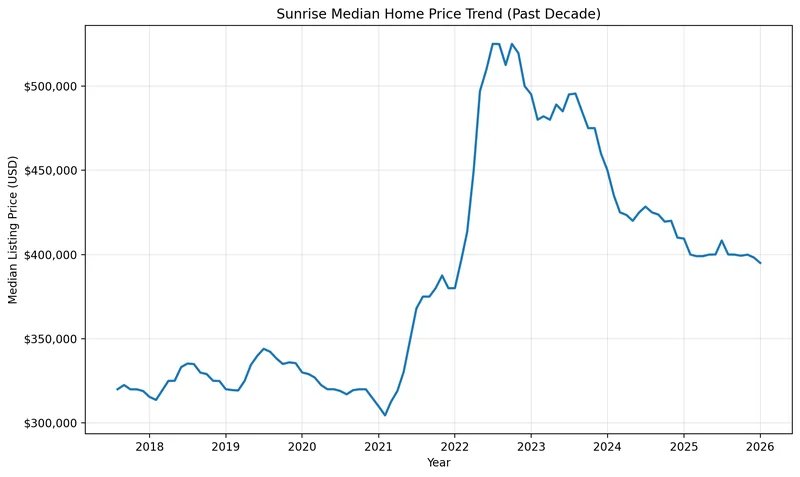
Chart of the Sunrise median home price trend over the past decade, used for Broward County estate planning and Sunrise Lady Bird Deed research
Sunrise median home price trend (past decade)
On a moderately valued home, probate costs eat a larger share of what the family keeps.

Remarriage: The Same Problem Running the Other Direction

The divorce problem is that a deed keeps saying something you no longer mean. The remarriage problem is the opposite: the deed still says what you mean, and the constitution overrides it.

When you marry, your new spouse acquires rights in your homestead that do not depend on being on the title, on contributing to the purchase, or on how long the marriage has lasted. Those rights come from Article X, Section 4 of the Florida Constitution, and they are among the strongest protections in Florida law.

  1. The devise restriction. If you are survived by a spouse and no minor child, the constitutional homestead may be devised only to that spouse. If you are survived by a minor child, it cannot be devised at all. A deed leaving the house to your children from a prior marriage runs directly into this.
  2. The joinder requirement. A conveyance of homestead requires the spouse to join in the deed, whether or not the spouse is on the title. This routinely surprises people who bought the house years before the marriage and think of it as entirely their own.
  3. Neither depends on how long you have been married. There is no waiting period. The rights attach on the wedding day.

What happens to a deed recorded before the marriage

It does not automatically become void. But it may not work, and the difference matters. A deed that purports to pass the homestead to your children, executed when you were single and now colliding with a surviving spouse's constitutional rights, is not a clean transfer. It is the opening position in a dispute between your spouse and your children over the house they are both living with the consequences of.

The result is litigation, in probate court, over property that was supposed to bypass probate court. Everyone loses except the professionals.

If you have remarried, put these on the list

  • Pull every deed recorded against the property, not just the newest one.
  • Confirm whether any deed names a former spouse.
  • Confirm whether the residence is your constitutional homestead.
  • Consider whether a properly drafted prenuptial or postnuptial agreement waiving spousal homestead and elective share rights is appropriate; these have specific execution requirements and are not do-it-yourself documents.
  • Decide, explicitly, what you want your spouse and your children each to receive, and then choose an instrument that can actually deliver it.

Avoiding Probate Is Not the Same as Avoiding the Elective Share

This is the most commonly misunderstood point on the entire page, and it is the one that most often surprises people who thought a recorded deed had settled the question.

Florida gives a surviving spouse the right to elect a share of the deceased spouse's elective estate rather than accept what was left to them. And the elective estate is deliberately drawn much wider than the probate estate, precisely so that it cannot be emptied out by non-probate transfers.

Fla. Stat. § 732.2035 defines what goes in. Two of its categories land squarely on a Lady Bird Deed:

Two ways a Lady Bird Deed property enters the elective estate
CategoryWhat it coversWhy it reaches your deed
Protected homestead The decedent's interest in property constituting the protected homestead. If the property was your homestead, it counts, regardless of how it passed.
Revocable transfers Property transferred by the decedent to the extent that, at the time of death, the transfer was revocable by the decedent alone or together with another person. A Lady Bird Deed is revocable by the grantor alone. That is its defining feature.

Read the second row slowly. The very characteristic that makes a Lady Bird Deed attractive (that you can undo it at any moment, that nothing has really left your control) is exactly the characteristic that pulls the property into the elective estate calculation.

The distinction that matters

Probate avoidance is about how title moves and how much it costs to move it. A Lady Bird Deed is excellent at this.

The elective share is about how much value a surviving spouse is entitled to claim from everything you owned or controlled. A Lady Bird Deed does not defeat it, and was never designed to.

For a first marriage where everything goes to the spouse anyway, this is academic. For a second marriage where the house is going to children from a first marriage, it is the central issue, and it is why blended-family planning that consists of a single recorded deed is not planning at all.

Spousal rights can be waived, but only through a properly executed marital agreement meeting Florida's specific requirements. That is a document to have drafted, not downloaded, and ideally before the wedding rather than after.

Source: Fla. Stat. § 732.2035 (property entering into elective estate), including subsections covering protected homestead and property subject to a retained power of revocation. The elective share percentage and computation are set by Fla. Stat. ch. 732, part II.

Married Couples: When Does the Deed Actually Operate?

Most married Florida homeowners hold their residence as tenants by the entireties, a form of co-ownership available only to spouses, which carries an automatic right of survivorship and, separately, a strong shield against the individual creditors of one spouse.

Its survivorship feature has a consequence people frequently get backwards. At the first spouse's death, the property passes to the survivor by operation of law. Not by will. Not by deed. Automatically, outside probate, regardless of what any other document says about it.

  1. First death: survivorship operates. The surviving spouse owns the whole property. Nothing in the Lady Bird Deed has done anything yet.
  2. Second death: now the enhanced life estate deed does its work, passing the property to the named remainder beneficiaries with no probate case.

A deed for a married couple therefore has to be drafted for a two-stage sequence: both spouses sign as grantors, both reserve the enhanced life estate, and the remainder beneficiaries take only after both are gone. A deed written as though it operates at the first death simply sits in the records doing nothing, and the family only discovers this years later.

Two further consequences worth knowing

Recording a deed can change the creditor picture. Tenancy by the entireties protects the home from a creditor of one spouse alone. Any change to how title is held deserves a moment's thought about whether that protection survives the way you expect, particularly where one spouse has business exposure.

The gap between the two deaths is where everything changes. The surviving spouse may live another fifteen years. They may remarry, which brings a new spouse's homestead rights into play. Children may die. Grandchildren may be born. This is precisely why a deed executed by a couple should be reviewed by the survivor after the first death, rather than treated as settled business. The survivor retains the full power to revoke, and often should.

Blended Families: The Honest Conversation

Here is the goal almost every remarried homeowner describes, in almost the same words: I want my spouse to be able to stay in the house for as long as they need it, and then I want it to go to my children.

It is a completely reasonable goal. A Lady Bird Deed on its own cannot deliver it, and it is worth being direct about why.

The deed transfers ownership at your death. Full stop, immediately, to whoever is named. There is no middle setting. If you name your spouse, the children have nothing and are dependent on your spouse's own estate plan, which your spouse can change the day after your funeral. If you name your children, your spouse may be a co-owner's tenant in the home they live in, subject to the constitutional homestead rights described above and to whatever relationship exists between them and your children.

Instruments measured against the blended-family goal
ApproachSpouse can stay?Children reliably receive it?Realistic assessment
Lady Bird Deed to spouse Yes No Your spouse can leave it to anyone. Trust without a mechanism.
Lady Bird Deed to children Not reliably Yes, if homestead rights do not defeat it Sets up a direct conflict between spouse and children.
Life estate to spouse, remainder to children Yes Yes Workable, but disputes over taxes, insurance and repairs are common and it is inflexible if the spouse needs to move.
Revocable trust with a life interest Yes Yes Does what people actually want: a trustee holds it, spouse occupies, children take later. Costs more.
Marital agreement plus a deed Depends on terms Yes, if rights are validly waived Strongest where both parties have counsel and the agreement is properly executed.

None of this means a Lady Bird Deed is the wrong tool. For a Sunrise owner in a first marriage leaving the house to children who get along, it is very often exactly the right tool: simple, inexpensive, effective, and revocable if anything changes.

It means that when a second marriage and children from a first marriage are both in the picture, the deed is one component of a plan and not the plan itself. An honest hour spent on that distinction is worth considerably more than a form.

Homestead Exemption and Save Our Homes

Recording a Lady Bird Deed does not disturb your homestead exemption or the Save Our Homes cap on annual assessment increases. You remain the owner and the resident, nothing is transferred, and nothing is reassessed.

Neither the exemption nor the cap passes to your beneficiaries. A beneficiary who moves in applies in their own name with the Broward County Property Appraiser, and the assessment resets to market value. On a Sunrise home held since the 1990s, that reset is significant, and beneficiaries planning to keep the property should see the projected number before they inherit rather than after.

A note for divorced owners

Divorce frequently changes who occupies the home, and the homestead exemption follows permanent residency, not the divorce judgment. An owner who moves out while a former spouse remains in the house should confirm the exemption status directly with the Property Appraiser rather than assume it continues. Losing the exemption without noticing produces a tax bill nobody budgeted for, and in some circumstances an assessment of back taxes.

It is also a useful prompt, because an owner reviewing their homestead exemption after a divorce is an owner in exactly the right frame of mind to review the deed at the same time.

Medicaid and Estate Recovery

Florida recovers long-term care Medicaid costs from a deceased recipient's probate estate. Property that passes by a properly drafted enhanced life estate deed never becomes a probate asset, so there is nothing for the state to file a claim against.

Florida also does not treat recording the deed as a disqualifying transfer for eligibility, because nothing was given away. You keep the power to sell the property and keep the proceeds, so no transfer penalty is triggered the way an outright gift to a child would trigger one.

The limits and one specific to this page

  1. A deed that has to be litigated is not a deed that avoided probate. If a former spouse's name on the instrument sends the property into a court proceeding, the probate-avoidance premise fails, and with it the estate recovery protection that depended on it.
  2. Marital status affects eligibility itself. Florida's rules treat a married applicant very differently from a single one, including the resources a community spouse may keep. A divorce or a remarriage should trigger a fresh look at any long-term care plan.
  3. It covers only real property. Bank accounts, brokerage accounts and vehicles without beneficiary designations still go through probate, where a claim can reach them.
  4. Timing matters. The deed is far more useful recorded years in advance than executed during a hospital discharge conversation.

Sources: 42 U.S.C. § 1396p; Fla. Stat. §§ 409.910 and 409.9101; Art. X, § 4, Fla. Const.

Recording a Sunrise Lady Bird Deed

Where it goes

Broward County is one of Florida's exceptions. Deeds are recorded by the Broward County Records, Taxes & Treasury Division at 115 South Andrews Avenue, Room 114, Fort Lauderdale, not by the Clerk of the Circuit Court, which handles recording in most Florida counties. Searching for "clerk of court deed recording" sends people to the wrong building.

Execution requirements

A deed conveying an interest in Florida real property must be signed by the grantor in the presence of two subscribing witnesses and acknowledged before a notary public (Fla. Stat. §§ 689.01 and 695.03). Both witnesses must be present and both must sign. A notary may serve as one of the two if the notary genuinely witnessed the signing, though two independent witnesses removes the argument.

Spousal joinder, and getting the revocation language right

If you are married and the property is your homestead, your spouse must join in the deed, whether or not they are on title. This is constitutional, not optional, and a deed missing it is a title defect.

Where you are replacing an earlier deed (which is the entire point after a divorce), the new instrument must expressly revoke and supersede the prior one, identifying it by its recording book and page or instrument number. Two recorded deeds naming different beneficiaries, with nothing connecting them, is not an update. It is an ambiguity, and a title underwriter will treat it as one.

Recording fees and documentary stamp tax

Recording fees in Broward County are $10.00 for the first page and $8.50 for each additional page, plus $1.00 for each name over four that must be indexed.

Documentary stamp tax on a deed is charged at $0.70 per $100 of consideration outside Miami-Dade County. A Lady Bird Deed given for no consideration on an unencumbered homestead generally carries only minimal tax. If there is a mortgage, the outstanding balance is treated as consideration, and the tax should be calculated before signing. This matters particularly after a divorce, where one spouse has often refinanced to buy out the other and the balance is larger than it used to be.

Sources: Florida Department of Revenue, Technical Assistance Advisement 20B4-004 (Oct. 16, 2020); Fla. Stat. ch. 201; Fla. Stat. § 28.24(13) (statutory service charges) together with the Broward County recorder's published fee schedule; Fla. Stat. §§ 689.01, 695.03.

After a Death: What Your Family Actually Does

  1. Order certified death certificates

    From the Florida Department of Health. Order several: the property appraiser, the insurer, the bank and any lender will each want one.

  2. Record one against the property

    A certified copy is recorded in the Broward County Official Records against the folio. That filing is what makes the transfer visible in the chain of title. No petition, no court file, no personal representative.

  3. Pull the full chain of title first, if there was a divorce

    Specific to this page: before recording anything, have someone read every instrument in the chain. A prior deed naming a former spouse is far easier to address early than at a closing two years later.

  4. Notify the insurer

    Homeowner's coverage must be rewritten in the new owners' names. A lapse discovered after a loss cannot be undone.

  5. Contact the lender, if there is a mortgage

    The loan follows the property. Federal law generally protects a relative who inherits a home from due-on-sale acceleration, but the lender still needs to know who is paying.

  6. Apply for their own homestead exemption, if applicable

    A beneficiary who moves in applies with the Broward County Property Appraiser in their own name. Nothing carries over, including the Save Our Homes cap.

  7. Provide an affidavit if a title company asks

    On a later sale or refinance an underwriter may want a short affidavit confirming the deed was never revoked and identifying the beneficiaries. Routine, and far less work than a probate case.

What a Sunrise Lady Bird Deed Does Not Do

The honest limits
It doesIt does not
Pass the home outside probate to the beneficiaries it names. Update itself when you divorce. Nothing does.
Leave you free to sell, mortgage, lease or revoke without anyone's consent. Override a new spouse's constitutional homestead rights.
Keep the property out of the probate estate for Medicaid recovery purposes. Keep it out of the elective estate. § 732.2035 reaches revocable transfers.
Preserve your homestead exemption and Save Our Homes cap during your life. Transfer that cap to your beneficiaries.
Give beneficiaries a stepped-up basis at your death. Wipe out the mortgage, which follows the house.
Work alongside a will, a trust and beneficiary designations. Cover bank accounts, brokerage accounts or vehicles.
Give a spouse the home outright, or give children the home outright. Give a spouse the use of it now and children the ownership later. That takes a trust or a true life estate.
Be revoked or replaced at any time while you are competent. Do anything at all if you lose capacity before signing it.

How a Sunrise Lady Bird Deed Compares to the Alternatives

Options for passing a Sunrise home
Option Avoids probate? Keeps control? Auto-updates on divorce? Main drawback
Lady Bird Deed Yes Yes, full power to sell or revoke No Must be updated by hand after a divorce or remarriage
Will alone No Yes Yes, § 732.507(2) A full Broward probate case on the house
Revocable living trust Yes Yes Depends on its terms Higher cost; must be funded and maintained
Traditional life estate deed Yes No, remaindermen must consent to sell No, and it cannot be undone at all You lose control of your own home
Outright gift to children now Yes No, it is theirs No Medicaid transfer penalty, loss of stepped-up basis, exposure to their creditors and divorces
Adding a spouse or child to the deed Partly No No, and a divorce leaves them a co-owner Gift tax exposure, their creditors reach your home, and you cannot undo it

Column four is the point of this page. A will updates itself on divorce. A deed does not. That is not an argument for choosing the will: the will costs your family a probate case, which is exactly what you were trying to avoid. It is an argument for putting the deed on your post-divorce checklist next to the retirement account and the life insurance, because those three items are not treated the same way by Florida law even though they feel identical.

Florida, worth repeating, has no transfer-on-death deed. Owners who moved here from a state that offers one are often surprised. The Lady Bird Deed is Florida's functional equivalent, and it exists by practice and title custom rather than by a statute of its own, which is precisely why nobody wrote an automatic-revocation rule for it.

How to Get a Sunrise Lady Bird Deed

  1. Pull every deed recorded against the property

    Not just the newest one. Divorce-era quitclaims, an older enhanced life estate deed, a deed from a prior marriage: all of it is part of the picture, and some of it may still be operative.

  2. Confirm your marital status and how title is held

    Married owners usually hold homestead as tenants by the entireties, which means survivorship at the first death and the deed operating at the second.

  3. If you are divorced, check for an ex-spouse on the deed

    Florida's automatic revocation on dissolution does not extend to deeds. If they are named, they stay named until you record something that removes them.

  4. If you have remarried, address your new spouse's homestead rights

    These attach on the wedding day and do not depend on being on title. Decide deliberately how to handle them.

  5. Read the divorce judgment and marital settlement agreement

    These frequently contain obligations about the house, life insurance or the children's interests that the deed has to be consistent with.

  6. Draft the enhanced life estate reservation

    Full reserved power to sell, convey, mortgage, lease and revoke without the consent of the remainder beneficiaries. Weak reservation language is the single most common defect in form deeds.

  7. Include express revocation of the prior deed

    Identify the earlier instrument by book and page or instrument number and state that this deed revokes and supersedes it.

  8. Sign with two witnesses, a notary, and any required spousal joinder

    Fla. Stat. §§ 689.01 and 695.03, plus the constitutional joinder requirement if the property is homestead and you are married.

  9. Record with Broward Records, Taxes & Treasury

    115 South Andrews Avenue, Room 114, Fort Lauderdale. $10.00 first page, $8.50 each additional page, $1.00 per name over four.

Plain-English Glossary

Terms that come up after a divorce or a remarriage
TermWhat it means here
Enhanced life estate deedThe formal name for a Lady Bird Deed. You keep everything during your life, including the right to cancel it.
Dissolution of marriageFlorida's term for divorce. The trigger for the automatic revocation statutes, which do not reach deeds.
Tenancy by the entiretiesCo-ownership available only to married couples, with automatic survivorship and protection from the individual creditors of one spouse.
Right of survivorshipThe surviving co-owner takes the whole property automatically, outside probate, regardless of any will or deed.
Elective shareA surviving spouse's right to claim a share of the elective estate instead of accepting what was left to them.
Elective estateDeliberately broader than the probate estate. Includes protected homestead and property subject to a retained power of revocation.
Protected homesteadThe constitutional homestead, as distinct from the property tax exemption of the same name.
Spousal joinderThe requirement that a spouse sign a deed conveying homestead, whether or not the spouse is on title.
Devise restrictionThe constitutional limit on leaving homestead away from a surviving spouse or minor child.
Quitclaim deedA deed conveying whatever interest the grantor has, without warranties. Common in divorce settlements.
Marital agreementA prenuptial or postnuptial agreement. The route by which spousal homestead and elective share rights can be waived, subject to strict execution requirements.
Stepped-up basisYour beneficiaries' capital gains basis is the value at your death, not what you paid.

Sunrise Areas We Serve

We prepare Lady Bird Deeds for owners throughout Sunrise and the surrounding west Broward communities, including:

Sunrise Lakes Sunrise Golf Village Welleby Springtree Village Green Sawgrass Mills area Sawgrass Springs New River Estates Nob Hill corridor Sunset Strip Oakland Park Boulevard corridor Commercial Boulevard corridor Pine Ridge Bermuda Club Discovery Sunrise Bay Flamingo Road corridor University Drive corridor

All Sunrise property is recorded in the Broward County Official Records through the Records, Taxes & Treasury Division in Fort Lauderdale, and any probate case would be filed in the Seventeenth Judicial Circuit, Probate Division.

Work With a Sunrise Lady Bird Deed Attorney

Yanitza Schoonover focuses her practice on probate administration and estate planning for Florida families. She helps Sunrise owners with:

  • Sunrise Lady Bird Deed drafting, execution and recording
  • Post-divorce and post-remarriage deed review and correction
  • Formal and summary probate administration
  • Estate planning coordination for Florida homesteads


If you have divorced or remarried since anything was recorded against your home, that is the review to book. It is short, and it is far cheaper now than it will be for your family later.

Schedule Your Consultation
Sunrise Lady Bird Deed attorney Yanitza Schoonover

Yanitza Schoonover

Sunrise Lady Bird Deed Frequently Asked Questions

Does my divorce automatically remove my ex-spouse from my Lady Bird Deed?

Generally no, and this is the single most dangerous assumption in Florida estate planning. Fla. Stat. § 732.703 does void a designation to a former spouse on dissolution of marriage, but only for the assets that statute defines: life insurance policies and annuities, employee benefit plans, individual retirement accounts, payable-on-death accounts, and securities registered in transfer-on-death form. Real property conveyed by deed is not on that list. A separate statute, § 732.507(2), handles wills. Neither reaches a recorded deed. If your ex-spouse is named as a remainder beneficiary, the ordinary consequence is that they remain named until you record a new deed removing them.

What happens if I die with my ex-spouse still named on the deed?

The property is likely to pass to them at your death exactly as the deed says. Your children may have something to argue about (the divorce judgment, a marital settlement agreement, a theory of construction), but argue is the operative word. They would be filing a lawsuit against your former spouse to undo a recorded instrument, which costs money, takes time, and produces exactly the courtroom outcome the deed was recorded to avoid. Fixing it while you are alive costs a fraction of what contesting it will.

I remarried. Does my old Lady Bird Deed still work?

Not necessarily, and this is the mirror image of the divorce problem. When you remarry, your new spouse acquires constitutional homestead rights under Article X, Section 4 of the Florida Constitution. If you are survived by a spouse and no minor child, the homestead may be devised only to that spouse, and a conveyance of homestead generally requires the spouse to join in the deed. A Lady Bird Deed recorded before the marriage leaving the house to your children can run straight into those rights. The deed does not become void automatically, but it may not accomplish what it says, and the disagreement surfaces at the worst possible moment.

Can my surviving spouse claim the house even though the deed gave it to my children?

Possibly, through two separate routes. The first is the constitutional homestead devise restriction. The second is Florida's elective share. Under Fla. Stat. § 732.2035, the elective estate includes both the decedent's interest in protected homestead and property transferred by the decedent where, at the time of death, the transfer was revocable by the decedent alone or together with another person. A Lady Bird Deed is revocable by definition; that is the whole point of it. So the home's value can be counted in calculating what a surviving spouse may elect, even though the property itself passed outside probate. Avoiding probate and avoiding the elective share are two different things.

My spouse and I own the house together. When does the Lady Bird Deed actually operate?

Most married Florida couples hold their homestead as tenants by the entireties, which carries an automatic right of survivorship. At the first spouse's death the property passes to the survivor by operation of law, without probate and regardless of what any deed or will says. A Lady Bird Deed signed by both spouses therefore does its real work at the second death. It has to be drafted with that sequence in mind; a deed that assumes it operates at the first death simply sits there doing nothing for years.

Do I need my spouse to sign the deed?

If the property is your homestead and you are married, yes. Article X, Section 4(c) of the Florida Constitution requires a spouse to join in a conveyance of homestead, and that applies whether or not the spouse is on the title. This catches people who bought a house before marrying and assume it is theirs alone to deal with. It is theirs to own, but not theirs alone to convey.

What about the children from my first marriage?

This is where blended families need real planning rather than a form. The instinct is to let the surviving spouse live in the home and then have it pass to the children of the first marriage. A Lady Bird Deed alone is a blunt instrument for that: it transfers ownership at your death, full stop, which either cuts out the spouse or cuts out the children depending on who you name. Structures that actually accomplish the goal usually involve a trust, or a life estate paired with clear agreements, built with the constitutional homestead rules in view from the start.

Where do I record a Lady Bird Deed for Sunrise property?

With the Broward County Records, Taxes & Treasury Division, at 115 South Andrews Avenue, Room 114, Fort Lauderdale. This surprises people because in most Florida counties the Clerk of the Circuit Court handles recording; in Broward it is a county division. Recording fees are $10.00 for the first page and $8.50 for each additional page, plus $1.00 for each name over four that has to be indexed.

Will a Sunrise Lady Bird Deed affect my homestead exemption?

No. You remain the owner for every practical and legal purpose during your lifetime, so your homestead exemption and your accumulated Save Our Homes cap both continue undisturbed. Neither transfers to your beneficiaries at your death; a beneficiary who moves in must apply in their own name with the Broward County Property Appraiser, and the assessment resets to market value.

Does a Sunrise Lady Bird Deed protect the home from Medicaid estate recovery?

In practice it usually does, because Florida limits estate recovery to the probate estate. Property passing by a properly drafted enhanced life estate deed is not part of the probate estate, so there is nothing for the state to recover against. Florida also does not treat the deed as a disqualifying transfer for eligibility, since you keep full control during your life. Note the connection to the rest of this page: a deed ambiguous enough to require a court proceeding has not avoided probate, and therefore fails at both jobs at once.

Can a Sunrise Lady Bird Deed be revoked?

Yes, and after a divorce or a remarriage that is exactly what should happen. Because you reserve the power to sell, convey, mortgage, lease and revoke without anyone's consent, you can record a new deed that revokes or replaces the old one at any time while you are competent. Your named beneficiaries, including a former spouse, have no vote and no veto. What you cannot do is fix it after you die, which is why this belongs on the same post-divorce list as the retirement account and the life insurance.

Do my beneficiaries get a stepped-up basis?

Yes. Because the transfer takes effect at your death rather than during your life, your beneficiaries take the property with a basis equal to its fair market value on the date of death. On a Sunrise home held since the 1980s or 1990s, that step-up can erase a very large capital gain that an outright lifetime gift would have handed straight to your children.


We also assist owners in nearby Broward markets including Plantation, Davie, Coral Springs, Pembroke Pines, Fort Lauderdale, and Miramar. Browse every market on our areas we serve page.

Florida Lady Bird Deed Attorney Serves Homeowners Across Florida

We help homeowners throughout Florida with Lady Bird Deeds and probate avoidance planning. Below are many of the primary Florida markets we serve, but we're not limited to these locations. You can also browse the full Florida Lady Bird Deed city and county directory.

Boca RatonBoynton BeachCape CoralClearwaterCoral SpringsDavieDaytona BeachDeerfield BeachDoralFort LauderdaleHallandale BeachHialeahHollywoodHomesteadJacksonvilleKendallLauderdale LakesMiamiMiami BeachMiramarOrlandoParklandPembroke PinesPine HillsPlantationPompano BeachPort Saint LucieSaint PetersburgSunriseTallahasseeTampaWest Palm BeachWeston

Legal disclaimer. This page is general information about Florida law, not legal advice, and reading it does not create an attorney-client relationship. The effect of a dissolution of marriage or a subsequent marriage on a particular recorded deed depends on that deed's language, on the terms of the divorce judgment and any marital agreement, and on the facts, and some assets are governed by federal law that displaces state rules. Any such deed should be reviewed with counsel rather than assumed to work. Recording locations, fees, tax rates and court procedures described were accurate as of August 2026 and should be confirmed with Broward County Records, Taxes & Treasury and the Florida Department of Revenue.

The Schoonover Law Firm, P.A. · Yanitza Schoonover, Attorney at Law · Licensed in Florida. Attorney advertising.