Jacksonville Lady Bird Deed Attorney

A Jacksonville Lady Bird Deed, known formally as a Florida enhanced life estate deed, lets your home or condominium pass directly to the beneficiaries you name at your death, with no Duval County probate case on that property. Nothing changes while you are alive: you stay on title, you keep whatever homestead exemption you qualify for, and you can live in the property, rent it, refinance it, sell it, or revoke the deed entirely.

Jacksonville is a working city with a young profile by Florida standards. 14.9% of residents are 65 or older, 57.6% of housing is owner-occupied, the median owner-occupied home is worth $293,700, and median household income is $69,872.

It is also a Navy town. NAS Jacksonville sits on the St. Johns River and Naval Station Mayport sits at the mouth of it, and between them they anchor a population of active duty families, reservists and retirees who bought houses here. That population has a planning problem most Florida homeowners do not have, and it is the subject of this page: the state that issues your orders and the state that claims you as a resident are not the same thing, and neither is decided by where the house is.

Jacksonville Lady Bird Deed: the short version

  • What it does: names beneficiaries who receive the property automatically at death, outside of probate.
  • What you keep: full control for life, with the freedom to sell, rent, refinance, or revoke without anyone's permission.
  • Domicile is not duty station. Homestead protections and the homestead exemption follow domicile and permanent residency, not orders.
  • The deed works either way. It operates on Florida real property regardless of where the owner is domiciled.
  • Built for people who move. The enhanced reservation lets you sell on PCS orders without a beneficiary's signature.
  • Sign before you deploy. Two witnesses and a notary are easy at home and very hard at sea.
  • Where it records: the Clerk of the Circuit and County Courts, Duval County, downtown or at the Beaches branch.

What Is a Jacksonville Lady Bird Deed?

A Jacksonville Lady Bird Deed is the common name for a Florida enhanced life estate deed recorded on property in Duval County. It names the beneficiaries, called remaindermen, who receive the property automatically at your death, while reserving to you an enhanced life estate that leaves you in complete control while you are alive.

The word doing the work is enhanced. A traditional life estate deed also names remaindermen, but it strips you of the ability to act alone: no sale, no mortgage, no change of mind without every beneficiary signing. For a family that expects to be somewhere else in three years, that is not a plan. An enhanced life estate deed reserves the power to sell, convey, mortgage, lease and revoke without their consent.

The recording formalities come from Fla. Stat. §§ 689.01 and 695.03. The enhanced reservation itself is a creature of Florida practice and title custom rather than a statute written for it, which is why the drafting matters. A weak reservation reads like a traditional life estate to a title underwriter, and then the people you never meant to give a present interest to are people whose signatures a closing needs.

For a broader comparison, see our guide to Lady Bird Deeds versus wills, trusts and quitclaim deeds.

Jacksonville Lady Bird Deed attorney helping Duval County homeowners avoid probate

Domicile, Duty Station and the Jacksonville House

Start with the distinction that causes the most confusion in a military town. Domicile and duty station are different things. A servicemember stationed in Florida may be domiciled elsewhere, and one domiciled in Florida may be stationed elsewhere. Orders move your body. They do not, by themselves, move your legal home.

Domicile is the place you treat as your permanent home and intend to return to. A sailor who entered service from Ohio and has since served at Norfolk, San Diego and now Mayport may be domiciled in Ohio the whole time. This matters because homestead protections and the homestead exemption follow domicile and permanent residency, not orders. Both of the things Florida calls homestead attach to permanent resident status rather than to presence at a base.

Two homesteads, one word

  • The homestead exemption is a property tax benefit administered by the county property appraiser, and it requires that the property be your permanent residence.
  • The constitutional homestead under Art. X, § 4, Fla. Const. is a creditor protection and a restriction on transfer, with rules about spousal joinder and about who the property may be left to.
  • Neither follows a duty station. Orders to NAS Jacksonville do not confer them, and orders away do not automatically strip them if Florida remained your domicile.

Now the part that surprises people. A Lady Bird Deed works on Florida real property regardless of where the owner is domiciled. Florida decides how title to Florida land moves, and it does not ask which state issued your driver's license before deciding whether a recorded deed is effective.

Follow that through. A chief petty officer stationed at Mayport owns a house in Atlantic Beach and is domiciled in Texas. If she dies owning that house, it is still Florida land, and a Texas will does not move Florida title by itself. Her family is generally looking at a Florida proceeding on top of whatever is happening in Texas.

So for a family stationed here but domiciled elsewhere, the deed is still worth recording purely to keep the Florida house out of a Florida court. That is a narrower goal than a lifelong Florida resident has, and it is a sufficient reason on its own. You are removing the one asset that would otherwise force your family to appear in a state they do not live in.

The mirror image is just as common. A family domiciled in Florida owns a house in Mandarin, gets orders overseas, rents it out and leaves. Their domicile does not evaporate because they were ordered away, but the exemption question becomes fact-dependent. Either way the deed is the stable part, and it keeps working while you are gone.

The Deployed Servicemember Homestead Exemption

Separate from the deed, and worth knowing because many Jacksonville families who qualify never claim it, Florida provides an additional property tax exemption tied to deployment.

Fla. Stat. § 196.173 provides an additional ad valorem homestead exemption for a servicemember who receives a homestead exemption and who was deployed during the preceding calendar year on active duty outside the continental United States, Alaska or Hawaii in support of a designated military operation.

Each condition is doing work. You must already receive a homestead exemption, which loops back to domicile. The deployment must have been in the preceding calendar year, outside the continental United States, Alaska or Hawaii, and in support of a designated military operation.

How the amount is calculated

  • The exemption amount equals the taxable value of the homestead on January 1,
  • multiplied by the number of days deployed in the preceding calendar year,
  • divided by the number of days in that year.
  • It is prorated to actual deployment, not a flat amount, so a partial year produces a partial exemption.

The filing requirement is what trips people up. Application is filed with the property appraiser by March 1 of the year following the qualifying deployment, on a department-prescribed form, with proof of deployment and dates. A sailor who returns in November has about three months to gather documentation, during exactly the period when the property appraiser is furthest from mind. Keeping the orders and the dates somewhere the family can find them is a small habit that pays.

A properly drafted Lady Bird Deed should not disturb your homestead exemption during your lifetime, since you remain the owner of record in possession, so it should not interfere with the additional exemption either. But neither does the other's job. Recording a deed applies for nothing, and filing an exemption application moves no title.

Sources: Fla. Stat. § 196.173 (additional ad valorem exemption for a servicemember who receives a homestead exemption and who was deployed during the preceding calendar year on active duty outside the continental United States, Alaska or Hawaii in support of a designated military operation; amount equal to the taxable value of the homestead on January 1 multiplied by the number of days deployed in the preceding calendar year, divided by the number of days in that year; application filed with the property appraiser by March 1 of the year following the qualifying deployment, on a department-prescribed form, with proof of deployment and dates). Eligibility depends on your specific deployment and residency facts. Confirm with the county property appraiser.

Jacksonville Estate Planning Snapshot

A large, young, mid-priced market with a working-age ownership base and a substantial military population.

  • 14.9% of Jacksonville residents are age 65+
  • 57.6% of housing units are owner-occupied
  • $293,700 median value of owner-occupied housing
  • $69,872 median household income
  • 12.5% of residents are foreign-born
  • 16.7% speak a language other than English at home

At 14.9% aged 65 or older, Jacksonville is noticeably younger than the coastal retirement markets elsewhere on this site. The conversation here is less often about long-term care and more often about a family in their thirties with a mortgage, young children and a next duty station.

A median owner-occupied value of $293,700 against household income of $69,872 describes an attainable market. That is part of why service families buy here rather than rent, and it is why the house is so often the largest thing in the estate. When the house is the whole estate, keeping it out of probate is close to keeping the estate out of probate.

The 57.6% owner-occupancy figure carries a second implication: a meaningful share of Jacksonville houses are owned by people not living in them, including families who kept a house after orders moved them on. Those owners are exactly the ones for whom a recorded deed is most valuable and least likely to have been done.

Demographic figures: U.S. Census Bureau QuickFacts, Jacksonville city, Florida (most recent American Community Survey five-year estimates available at publication).

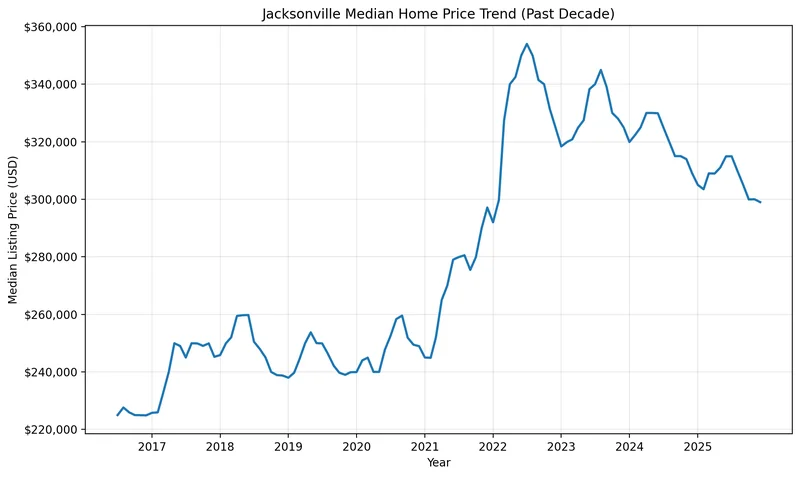
Chart of the Jacksonville median home price trend over the past decade, used for Duval County estate planning and Jacksonville Lady Bird Deed research
Jacksonville median home price trend (past decade)
The steeper this line, the more equity sits in a house that may still be titled the way it was at closing.

Moving on Orders: Why the Enhanced Reservation Matters

Most estate planning advice quietly assumes stability. Military families live the opposite pattern. Frequent relocation is exactly the situation the enhanced reservation is built for: you can sell on short notice, on PCS orders, without asking any beneficiary to sign.

Two deeds that look similar on paper and behave completely differently when orders drop.
 Enhanced life estate deedTraditional life estate deed
Can you sell alone?YesNo, every remainderman signs
Can you refinance alone?YesNo
Can you rent it out?YesLimited by the remainder interest
Can you change your mind?Yes, revoke and record a new deedNot without their consent
Avoids probate on that property?YesYes
What happens when orders drop?Nothing. You list the house.You start locating and negotiating with beneficiaries.

Picture the bad version. A traditional life estate deed names three adult children. Orders arrive with a report date ninety days out. Each of them has to be located, sign in front of the right witnesses, and return the paperwork. One is deployed. One has stopped speaking to a sibling. One wonders aloud whether the price is fair, because they hold a present interest and are entitled to wonder. Nobody is being unreasonable. The instrument simply handed them a veto over your move.

With an enhanced life estate deed none of that exists. You list, you close, and the remainder interest is extinguished by your own exercise of the reserved power. You then record a new deed on the next house.

A practical rhythm for a family that moves

  • Record a deed on each house you own. The deed covers only the property described in it.
  • Revisit it whenever the family changes. A marriage, a divorce, a birth or a death changes who should be named.
  • Do not delay because you might move. The possibility of moving is an argument for this deed, not against it.
  • If you keep a house after moving away, the deed keeps working. The out-of-state rental is what most often gets forgotten.

One caution. Because you can revoke or sell without telling anyone, a named beneficiary has no assurance of receiving anything, and what they eventually receive may carry a mortgage taken out years after the deed was signed. That is the design, not a defect, but it makes the deed a poor substitute for a conversation with the people you are naming.

Signing Before Deployment, Not During It

Here is the most practical advice on this page, and it has less to do with the law of deeds than with logistics. A deployed or deploying servicemember cannot easily appear before two witnesses and a notary at short notice. Plan the signing before deployment, not during it.

Florida requires a deed conveying an interest in real property to be signed in the presence of two subscribing witnesses and acknowledged before a notary public, under Fla. Stat. §§ 689.01 and 695.03. That is three other people at the same time as you. On a Tuesday afternoon in Jacksonville that is a scheduling nuisance. Aboard a ship, eight time zones from everyone who needs to be present, it becomes something else.

The pattern is consistent. The family means to do the deed, the pre-deployment period fills with everything else, and somebody says they will handle it from overseas. Then the document that was supposed to keep the house out of probate does not exist, because the one step that could not be done remotely was the step left for later.

Build it into the pre-deployment checklist

  • Start early. Drafting is fast. Pulling the legal description and coordinating a signing is what takes calendar time.
  • Bring the spouse. On homestead property a married owner's spouse joins the deed, whether or not the spouse is on title.
  • Use two real witnesses. Both present, both signing. Witnesses added afterward are the most common defect we see.
  • Do it with the other paperwork. The pre-deployment period already has a documents session in it.
  • Do not wait for a better time. The deed can be revoked or replaced at will, so signing early costs you nothing.

The same logic applies to illness. Deeds signed at a hospital or care facility without proper witnessing fail this test regularly, and the failure surfaces at death when it can no longer be corrected. A deed that was never validly executed is not a deed that mostly worked. It is a house going through probate.

What the Deed Does Not Touch

Estate planning is not one system. It is several parallel systems that do not talk to each other, and the deed is only one of them.

Beneficiary designations on service-related benefits are separate from the deed and are governed by their own forms. Whatever you filed, you filed through the channel that administers that benefit. A deed recorded in the Duval County Official Records has no effect on it, and updating a designation does not change a deed.

This surfaces at predictable moments: after a divorce, when a designation filed during the marriage was never revisited; after a remarriage; after the birth of a child. In each case the family finds the mismatch at the worst moment, and by then the form controls, not the intention.

The parallel systems, briefly

  • The deed controls a specific piece of Florida real property, recorded in the county Official Records.
  • Beneficiary designations on service-related benefits are governed by their own forms and their own channel. Review them there.
  • Financial account designations, where they exist, control those accounts and nothing else.
  • The will catches what nothing else covers, and it is what a court applies to the probate estate.
  • None of these update each other. Reviewing one is not reviewing the others.

Review them on the same occasion, and write down where each one lives. Families spend real time after a death working out what existed and where, and a single page listing the property, the deed and the accounts removes most of that.

Homestead Exemption, Save Our Homes and Spousal Rights

A properly drafted Jacksonville Lady Bird Deed should not disturb your homestead exemption or your Save Our Homes assessment cap during your lifetime. You retain the enhanced life estate, you remain in possession, and the Duval County Property Appraiser continues to treat you as the owner of record.

On the constitutional side, a married owner cannot convey homestead without the spouse joining in the deed, whether or not the spouse appears on title, and homestead cannot be devised away from a surviving spouse or a minor child. These restrictions are tested at death rather than at signing, which is why a deed that looked fine for years can fail at the moment it is needed. Where there is a minor child, a deed naming someone else is an area to analyze carefully rather than assume.

Spousal joinder deserves emphasis in a community where one spouse is frequently away. That signature is witnessed and notarized like the owner's, and it cannot be handled later by a phone call. Plan for both signatures at once.

Save Our Homes and the reset at death

Florida caps annual increases in the assessed value of a homestead, which over time produces a gap between market and assessed value. That gap does not survive you. Save Our Homes resets on the change of ownership at death, whether the property passes by Lady Bird Deed, through probate, or out of a trust. A beneficiary who moves in applies for their own exemption and starts their own cap. No instrument prevents the reset, and it is better for the family to expect it than to meet it in a tax bill.

The offsetting news is federal. Because the property stays in your gross estate, the basis resets to date-of-death value, which can eliminate most of the capital gain your beneficiaries would otherwise face on a later sale. It is the strongest argument against the well-meaning instinct to deed the house to the children during your lifetime, which forfeits the step-up entirely. Confirm the tax treatment with a tax advisor.

Sources: Art. X, § 4, Fla. Const. (constitutional homestead, spousal joinder to convey, restriction on devise where there is a surviving spouse or minor child); Fla. Stat. §§ 689.01, 695.03 (execution).

Medicaid and Estate Recovery

Florida's Medicaid program is required by federal law to seek reimbursement from the estates of recipients aged 55 and over who received long-term care benefits, and the word doing all the work is estate. Florida defines it narrowly: recovery reaches assets passing through the probate estate. Florida has not adopted the expanded definition some states use.

Because a Lady Bird Deed moves the home outside probate, it is one of the standard tools for reducing estate recovery exposure on a Florida homestead. Recording it is not a transfer for the five-year look-back, because nothing leaves your control during your lifetime.

With 14.9% of Jacksonville residents aged 65 or older, this is a smaller slice of the population than in the retirement markets to the south, but it includes many military retirees who settled near the bases. For an adult child in Riverside or Mandarin planning for a parent, this section is often the reason the appointment gets made.

The limits

  • The deed does not qualify anyone for Medicaid. Eligibility is a separate analysis.
  • The five-year look-back applies to transfers of non-homestead assets.
  • Protection depends on the home keeping homestead status and passing to heirs; a will directing a sale undoes it.

Our full write-up is on the Florida Lady Bird Deed and Medicaid page.

Sources: 42 U.S.C. § 1396p; Fla. Stat. §§ 409.910 and 409.9101; Art. X, § 4, Fla. Const.

Recording a Jacksonville Lady Bird Deed

Jacksonville and Duval County have a consolidated city-county government, which is unusual in Florida and worth noting first. Most Florida cities sit inside a county that is a separate layer with separate offices. Here the two are largely the same government, so you are not choosing between a city office and a county office.

Deeds are recorded through the Clerk of the Circuit and County Courts, Duval County, in the Official Records. The downtown location is 501 West Adams Street, Jacksonville, generally open 8 a.m. to 5 p.m. weekdays. There is also a Beaches branch in Neptune Beach. E-recording is available.

For an owner in Jacksonville Beach, Neptune Beach, Atlantic Beach or the Mayport area, the Beaches branch is usually the practical choice. For a family already out of state on orders, e-recording is generally the answer.

One statewide point that catches people who have owned in more than one Florida county, which describes many military families: the recording office varies by county and the offices are not interchangeable. Broward County uses its Records, Taxes & Treasury Division. Orange County uses the County Comptroller. Duval County uses the Clerk of the Circuit and County Courts.

Execution requirements

Florida requires a deed conveying an interest in real property to be signed in the presence of two subscribing witnesses and acknowledged before a notary public (Fla. Stat. §§ 689.01 and 695.03). Both witnesses must be present and must sign. On homestead property a married owner's spouse joins the deed. As above, this is the step to plan around a deployment schedule rather than assume.

Recording fees and documentary stamp tax

Recording charges are $10.00 for the first page, $8.50 for each additional page, and $1.00 per name indexed beyond four names. Duval County applies the standard statewide documentary stamp rate of $0.70 per $100 of consideration on taxable deeds.

Whether the tax applies to this deed at all was addressed in Technical Assistance Advisement 20B4-004 (October 16, 2020), in which the Florida Department of Revenue concluded that an enhanced life estate deed is not subject to documentary stamp tax, because no present beneficial interest transfers when the deed is signed. A Technical Assistance Advisement binds the Department only as to the taxpayer and facts presented. Where the property carries a mortgage, the analysis turns on whether there is consideration, which matters in a market where many owners bought recently.

Sources: Clerk of the Circuit and County Courts, Duval County, Official Records (501 West Adams Street, Jacksonville; generally 8 a.m. to 5 p.m. weekdays; Beaches branch in Neptune Beach; e-recording); Florida Department of Revenue Technical Assistance Advisement 20B4-004 (Oct. 16, 2020); Fla. Stat. ch. 201; Fla. Stat. § 28.24(13) (statutory service charges); Fla. Stat. §§ 689.01, 695.03.

After a Death: What Your Family Actually Does

  1. Order certified death certificates

    From the Florida Department of Health. Order several: the Property Appraiser, the insurer, any association and any lender will each want one.

  2. Record one against the property

    Recorded in the Duval County Official Records, this publicly establishes that the life estate has ended and the named beneficiaries hold title.

  3. Provide an affidavit if a title company asks

    On a sale or refinance, a title underwriter commonly wants an affidavit confirming identity, continuous marital status, and that the deed was never revoked.

  4. Expect the property tax bill to change

    The property is reassessed at market value following the change of ownership. This is the reset, and it arrives whether or not there was a deed.

  5. Apply for their own homestead exemption

    A beneficiary who moves in applies in their own name with the Duval County Property Appraiser, by the March 1 deadline for the year they qualify.

  6. Notify the insurer, the lender and any association

    All of them need to know who owns and occupies the property, and a lapse in coverage during a transition is a real risk.

  7. Deal with the other systems separately

    Beneficiary designations on service-related benefits are governed by their own forms and their own channel.

What is not on that list: a petition, a filing fee, a personal representative, publication of notice to creditors, or a creditor claim period for that property. For a family who may be living in another state when this happens, removing a Florida court appearance from the list is the whole value of the exercise.

If There Is No Deed: What Duval County Probate Looks Like

It helps to know what you are avoiding. Without a deed or other non-probate arrangement, Florida real property owned at death generally has to move through a court proceeding before anyone can sell it, refinance it, or give a title company something it will insure.

Florida provides an abbreviated route in some cases. Summary administration under Fla. Stat. § 735.201 is available where the estate qualifies, and the ceiling on non-exempt assets was raised to $150,000 effective July 1, 2026 by CS/SB 1500, for deaths on or after that date. In a market with a median owner-occupied value of $293,700, that widening brings more Jacksonville estates within reach of the shorter path.

It is still a court proceeding, and for a family scattered across duty stations it still means engaging with a Florida court from wherever they are. Qualifying is not automatic: the analysis turns on what is in the estate, what is exempt, and the date of death. A recorded Lady Bird Deed sidesteps the question entirely for the property it covers.

Sources: Fla. Stat. § 735.201 (summary administration); CS/SB 1500 (non-exempt asset ceiling raised to $150,000 effective July 1, 2026, for deaths on or after that date).

What a Lady Bird Deed Does Not Do

Common misconceptions, several of them specific to military families.
People assume it…Reality
Makes you a Florida residentNo. Domicile is a separate question and it is not decided by a deed or by orders.
Changes your service-related beneficiary designationsNo. Those are separate and are governed by their own forms.
Applies for the deployment exemption for youNo. That is filed with the property appraiser by March 1 of the year following the deployment.
Only works if you live in FloridaNo. It works on Florida real property regardless of where the owner is domiciled.
Passes your Save Our Homes cap to the kidsNo. It resets on the change of ownership at death. No instrument prevents that.
Passes your homestead exemption to the kidsNo. A beneficiary applies in their own name if they qualify.
Covers the whole estateOnly the real property described in it. Accounts, vehicles and belongings are untouched.
Replaces a willNo. You still want a will for everything the deed does not cover.
Overrides condominium or HOA documentsNo. Transfer approval, leasing limits and recorded assessments all still apply.
Qualifies you for MedicaidNo. It may reduce estate recovery exposure on a homestead, but it does not create eligibility.
Stops you from selling on ordersNo, and this is its strength. You can sell at any time without asking anyone.
Stops your children arguingNo. It hands them undivided shares. Any one of them can generally seek partition.

How a Jacksonville Lady Bird Deed Compares to the Alternatives

General comparison for a Florida homestead, with the relocation question added.
OptionAvoids probate?Sell on short notice alone?Preserves stepped-up basis?Typical drawback here
Lady Bird DeedYes, for that propertyYesYesCovers only the property described in it.
Will onlyNoYesYesGuarantees a Florida probate case on the house.
Revocable living trustYes, if fundedYes, as trusteeYesHigher cost, but better where you own in several states.
Deed the home to the kids nowYesNo, they own itNoForfeits the step-up and your own exemption at once.
Adding a child as joint ownerPartiallyNo, they must signPartially lostCreates a present co-owner with veto power and creditor exposure.
Traditional life estate deedYesNo, every beneficiary signsYesThe worst possible fit for a family that moves on orders.
Do nothingNoYesYesLeaves your family in a Florida court from wherever they are stationed.

Read the last two rows together. A traditional life estate deed and doing nothing are opposite failures: one takes away your flexibility while you are alive, the other takes away your family's ease after you are gone. A family that owns property in more than one state, which happens often in a military career, has a genuine reason to look at the trust row instead of stacking deeds in three jurisdictions. Our fuller breakdown is on the Florida Lady Bird Deed comparison page.

How to Get a Jacksonville Lady Bird Deed

  1. Work out where you are domiciled

    Duty station is not domicile. The answer drives the exemption questions, though not the deed itself.

  2. Confirm the deed fits your goals

    How the property is titled, who you want to receive it, whether you are married, and whether there is a minor child.

  3. Pull the vesting deed and parcel number

    The exact legal description from the Duval County Official Records, plus the parcel identification number.

  4. Draft the enhanced life estate reservation

    Reserving your power to sell, convey, mortgage, lease and revoke without the beneficiaries' consent, and naming contingent takers.

  5. Schedule the signing before deployment

    Not during it. Two witnesses and a notary are easy at home and very hard from a ship.

  6. Sign with two witnesses and a notary

    Both witnesses present and signing. A married owner's spouse joins the deed on homestead property.

  7. Record with the Duval County Clerk

    At 501 West Adams Street downtown, at the Beaches branch in Neptune Beach, or by e-recording.

  8. Review the other designations separately

    Service-related benefit designations are governed by their own forms, through their own channel.

START WITH A CONSULTATION

Plain-English Glossary

Enhanced life estate deedThe formal name for a Lady Bird Deed. You keep a life estate plus the power to sell, mortgage or revoke without anyone's consent.
DomicileThe place you treat as your permanent home and intend to return to. Not the same as where you are stationed.
Duty stationWhere your orders place you. It moves. Domicile does not move with it automatically.
Permanent residencyThe status the property appraiser looks at for the homestead exemption. It follows domicile, not orders.
Constitutional homesteadThe creditor shield and transfer restriction in Article X, Section 4. Different from the tax exemption of the same name.
Homestead exemptionThe property tax benefit administered by the county property appraiser on a permanent residence.
Save Our HomesThe constitutional cap limiting annual increases in the assessed value of homestead property. It resets at death.
RemaindermanA person named in the deed to receive the property at your death. No present interest while you are alive.
Spousal joinderThe requirement that a married owner's spouse sign the deed to convey homestead, whether or not the spouse is on title.
Stepped-up basisThe reset of cost basis to date-of-death value, which can eliminate accumulated capital gain on a later sale.
Summary administrationFlorida's abbreviated probate route for qualifying estates. Still a court proceeding.
Official RecordsThe county's public record of recorded documents, maintained here by the Clerk of the Circuit and County Courts.
Partition actionA lawsuit any co-owner can generally file to force the division or sale of jointly owned property.

Jacksonville Neighborhoods We Serve

We prepare Lady Bird Deeds for property throughout Jacksonville and Duval County, including:

  • Riverside
  • Avondale
  • San Marco
  • Ortega
  • Mandarin
  • Arlington
  • Southside
  • Baymeadows
  • Springfield
  • Murray Hill
  • Northside
  • Westside
  • Jacksonville Beach
  • Neptune Beach
  • Atlantic Beach
  • Julington Creek
  • Bartram Park
  • NAS Jacksonville area
  • Mayport area
  • Ponte Vedra border

Work With a Jacksonville Lady Bird Deed Attorney

Yanitza Schoonover focuses her practice on probate administration and estate planning for Florida families. She helps Jacksonville homeowners with:

  • Jacksonville Lady Bird Deed drafting, execution and recording
  • Planning before a deployment or a permanent change of station
  • Formal and summary probate administration
  • Estate planning coordination for Florida homesteads


If you have orders coming, the deed is the item on the list that cannot be done from overseas. Schedule a consultation before you leave and we will get it drafted, signed and recorded while everyone who needs to sign is still in the same city.

Schedule Your Consultation
Jacksonville Lady Bird Deed attorney Yanitza Schoonover

Yanitza Schoonover

Jacksonville Lady Bird Deed Frequently Asked Questions

I am stationed in Jacksonville but domiciled in another state. Can I still record a Lady Bird Deed?

Yes. A Lady Bird Deed operates on Florida real property, and Florida law governs the transfer of Florida land regardless of where the owner is domiciled. The Duval County house is what would draw your family into a Florida court, whatever state you called home, and recording the deed keeps it out. Domicile changes the tax and homestead side rather than the deed side, because homestead protections and the homestead exemption follow domicile and permanent residency, not orders.

Does being stationed in Florida make me a Florida resident?

No. Orders move you physically. Domicile is where you intend to remain permanently and return to, and it does not change because you were assigned to NAS Jacksonville or Naval Station Mayport. Some servicemembers keep the domicile they entered service with. Others deliberately establish Florida domicile and permanent residency. Neither is automatic, and the choice affects homestead exemption eligibility and the constitutional homestead protections.

What is the additional homestead exemption for deployed servicemembers?

Fla. Stat. § 196.173 provides an additional ad valorem homestead exemption for a servicemember who receives a homestead exemption and who was deployed during the preceding calendar year on active duty outside the continental United States, Alaska or Hawaii in support of a designated military operation. The exemption amount equals the taxable value of the homestead on January 1 multiplied by the number of days deployed in the preceding calendar year, divided by the number of days in that year, so it is prorated to actual deployment. Application is filed with the property appraiser by March 1 of the year following the qualifying deployment, on a department-prescribed form, with proof of deployment and dates.

Does that exemption have anything to do with the Lady Bird Deed?

They are separate. The exemption is a property tax benefit administered by the property appraiser and it depends on your receiving a homestead exemption and on your deployment record. The deed is a transfer instrument recorded in the Official Records. A properly drafted deed should not disturb your homestead exemption during your lifetime, so it should not interfere with the additional exemption either, but recording a deed applies for nothing and the March 1 deadline is yours to meet.

We move every two or three years on orders. Does a deed lock us into this house?

No, and frequent relocation is close to the ideal case for this instrument. The enhanced reservation keeps your power to sell, convey, mortgage, lease and revoke without the consent of the people named to receive the property. You can list the house the week orders drop, close, and record a new deed on the next house. No beneficiary has to be located or agree. A traditional life estate deed is the opposite.

I deploy in six weeks. Is there time to do this?

Usually yes, if you start now. The constraint is execution, not drafting. Florida requires two subscribing witnesses and a notary under Fla. Stat. §§ 689.01 and 695.03, and on homestead property a married owner's spouse joins the deed. That is straightforward at home and very difficult once you are at sea or forward deployed. Plan the signing before deployment, not during it.

Where is a Lady Bird Deed recorded in Duval County?

Deeds are recorded through the Clerk of the Circuit and County Courts, Duval County, in the Official Records. The downtown location is 501 West Adams Street, Jacksonville, generally open 8 a.m. to 5 p.m. weekdays. There is also a Beaches branch in Neptune Beach, which is the practical choice for owners in Jacksonville Beach, Neptune Beach, Atlantic Beach and the Mayport area. E-recording is available. Note that the recording office varies by Florida county and the offices are not interchangeable: Broward County uses its Records, Taxes & Treasury Division and Orange County uses the County Comptroller.

What does consolidated city-county government mean for my deed?

Jacksonville and Duval County have a consolidated city-county government, which is unusual in Florida. For deed purposes the effect is simple: the two are largely the same government, so your Jacksonville address and the Duval County records describe one jurisdiction rather than two layers. The deed is still recorded in the county Official Records through the Clerk of the Circuit and County Courts.

What are the recording fees and is documentary stamp tax due?

Recording charges are $10.00 for the first page, $8.50 for each additional page, and $1.00 per name indexed beyond four names. The standard statewide documentary stamp rate is $0.70 per $100 of consideration on taxable deeds. Florida Department of Revenue Technical Assistance Advisement 20B4-004 (October 16, 2020) concluded that an enhanced life estate deed is not subject to documentary stamp tax because no present beneficial interest transfers when the deed is signed. A Technical Assistance Advisement binds the Department only as to the taxpayer and facts presented. Where the property carries a mortgage, the analysis turns on consideration.

Does a Jacksonville Lady Bird Deed protect the home from Medicaid estate recovery?

Florida limits Medicaid estate recovery to assets that pass through the probate estate and has not adopted the expanded definition some states use. Because a Lady Bird Deed moves the home outside probate, it is one of the standard tools for reducing exposure on a Florida homestead. Recording it is not a transfer for the five-year look-back, because nothing leaves your control during your lifetime. The deed does not qualify anyone for Medicaid, the five-year look-back still applies to transfers of non-homestead assets, and the protection depends on the home keeping homestead status and passing to heirs. See our Medicaid guide.

Does the deed change who receives my service-related benefits?

No. Beneficiary designations on service-related benefits are separate from the deed and are governed by their own forms. A deed decides who takes a specific piece of Florida real property at your death. It has no effect on any designation you filed elsewhere, and changing a designation has no effect on the deed. Families get into trouble when they assume one document updated the other, usually after a divorce, a remarriage or the birth of a child. Review the designations through the proper channel on their own schedule.

More general questions are answered on our Florida Lady Bird Deed FAQ page.

We also assist homeowners across Florida including Daytona Beach, Orlando, Tallahassee, Tampa, Saint Petersburg, and Port St. Lucie. Browse every market on our areas we serve page.

Florida Lady Bird Deed Attorney Serves Homeowners Across Florida

We help homeowners throughout Florida with Lady Bird Deeds and probate avoidance planning. Below are many of the primary Florida markets we serve, but we're not limited to these locations. You can also browse the full Florida Lady Bird Deed city and county directory.

Boca RatonBoynton BeachCape CoralClearwaterCoral SpringsDavieDaytona BeachDeerfield BeachDoralFort LauderdaleHallandale BeachHialeahHollywoodHomesteadJacksonvilleKendallLauderdale LakesMiamiMiami BeachMiramarOrlandoParklandPembroke PinesPine HillsPlantationPompano BeachPort Saint LucieSaint PetersburgSunriseTallahasseeTampaWest Palm BeachWeston

Legal disclaimer. This page is general information about Florida law, not legal advice, and reading it does not create an attorney-client relationship. Nothing here is advice about your domicile, your residency status, or your eligibility for any exemption, all of which depend on your specific facts. Recording locations, fees, tax rates and court procedures described were accurate as of August 2026 and should be confirmed with the Clerk of the Circuit and County Courts, Duval County, the Duval County Property Appraiser and the Florida Department of Revenue.

The Schoonover Law Firm, P.A. · Yanitza Schoonover, Attorney at Law · Licensed in Florida. Attorney advertising.