Parkland Lady Bird Deed Attorney

A Parkland Lady Bird Deed, known formally as a Florida enhanced life estate deed, lets your home pass directly to the beneficiaries you name at your death, with no Broward County probate case on that property. Nothing changes while you are alive: you stay on title, you keep your homestead exemption, and you can live in the house, rent it, refinance it, sell it, or revoke the deed entirely.

Parkland is the youngest high-value market in Broward. Only 13.0% of residents are 65 or older, 85.1% of housing is owner-occupied, the median owner-occupied value is $983,000, and median household income is $198,669. These are families in their thirties and forties in large homes, most with children still in the house.

Which is why this page leads with something almost no Lady Bird Deed article mentions, and which matters more here than anywhere else on this site: Florida does not permit you to devise your homestead while a minor child survives you. Not to a trust, not by will, and not by Lady Bird Deed. It is a restriction on what you may do with your own house, and it is tested at your death rather than at signing.

Parkland Lady Bird Deed: the short version

  • What it does: names beneficiaries who receive the property automatically at death, outside of probate.
  • What you keep: full control for life, with the freedom to sell, rent, refinance, or revoke without anyone's permission.
  • The minor child rule: if a child under 18 survives you, the homestead cannot be devised, and a deed naming anyone else fails as to the homestead.
  • It is tested at death. A deed signed today can look valid for fifteen years and still not work.
  • It is not a dead end. A trust, life insurance and non-homestead assets do the work instead.
  • It expires. When your youngest turns 18, the restriction lifts and the deed becomes available.

What Is a Parkland Lady Bird Deed?

A Parkland Lady Bird Deed is the common name for a Florida enhanced life estate deed recorded on property in Broward County. It names the beneficiaries, called remaindermen, who receive the property automatically at your death, while reserving to you an enhanced life estate that leaves you in complete control while you are alive.

The enhancement is what separates it from an ordinary life estate deed. Under a traditional life estate you could not sell or mortgage without every named beneficiary signing, which for a family in its forties would be an unbearable constraint over the next thirty years. An enhanced life estate deed reserves the power to sell, convey, mortgage, lease and revoke without their consent.

The recording formalities come from Fla. Stat. §§ 689.01 and 695.03. The enhanced reservation itself is a creature of Florida practice and title custom rather than a statute written for it, which is why the drafting matters so much.

For a broader comparison, see our guide to Lady Bird Deeds versus wills, trusts and quitclaim deeds.

Parkland Lady Bird Deed attorney helping Broward County homeowners avoid probate

The Minor Child Rule

Article X, Section 4 of the Florida Constitution gives homestead property extraordinary protection from creditors. The same provision imposes a restriction most homeowners have never heard of: the homestead may not be devised if the owner is survived by a spouse or a minor child.

Read that carefully, because the two halves work differently. Where there is a surviving spouse but no minor child, the spouse can waive those rights in a properly executed agreement, and married couples routinely sign a Lady Bird Deed together to deal with it. A minor child cannot waive anything. There is no consent to obtain, no document to sign, and no workaround inside the deed itself.

What this means in practice

  • It applies to the constitutional homestead. Non-homestead property, a rental, a second home, an investment parcel, is not subject to the same restriction.
  • It is tested at death, not at signing. A deed signed when your children are grown is fine. A deed signed today, while they are nine and twelve, is measured against the facts on the day you die.
  • A minor child is anyone under 18 at your death, whether or not they live with you and whether or not they are financially dependent on you.
  • The deed does not become void. It simply fails to accomplish what it says as to the homestead, and the property descends under the statute instead.
  • It ends. The restriction lifts when your youngest child reaches 18, and at that point a Lady Bird Deed becomes an ordinary, sensible option.

The reason this matters so much in Parkland is arithmetic. With only 13.0% of residents 65 or older and a housing stock built for families, a large share of homeowners here fall squarely inside the restriction right now, and will for another decade or more. A form deed downloaded tonight and recorded tomorrow would look correct, record without objection, and fail at exactly the moment the family was relying on it.

Sources: Art. X, § 4(c), Fla. Const. (homestead devise restriction); Fla. Stat. § 732.4015 (devise of homestead). Whether particular property qualifies as constitutional homestead is a question of fact determined at death.

What Happens to the House Instead

If the homestead cannot be devised, it descends under Fla. Stat. § 732.401, and the statute is specific about how.

Where the owner is survived by a spouse and one or more descendants, the surviving spouse takes a life estate in the homestead, with a vested remainder to the descendants living at the owner's death, per stirpes. The spouse can live there for the rest of their life. The children own what comes after.

The statute also gives the surviving spouse an alternative. In place of the life estate, the spouse may elect to take an undivided one-half interest as a tenant in common, with the remaining half vesting in those same descendants. Which of the two is better depends entirely on the family's circumstances, and it is not obvious in advance.

The six-month deadline

The election must be made within six months after the decedent's death and during the surviving spouse's lifetime. That is a genuine deadline running from the worst six months of a family's life, and it is the sort of thing a grieving spouse discovers on month seven.

The two outcomes under Fla. Stat. § 732.401 where a spouse and descendants survive.
 Life estate (the default)Undivided one-half as tenant in common (by election)
Spouse's right to live thereFor lifeShared, as a co-owner
Children's interestVested remainder, taking effect at the spouse's deathAn undivided half, owned now
Selling the houseNeeds the remaindermen, and a guardian if any are minorsNeeds all co-owners, and a guardian if any are minors
Who pays taxes and upkeepGenerally the life tenantShared between co-owners
DeadlineNone, it is the defaultSix months after death, during the spouse's lifetime

There is one important exception, and it changes the answer for many married couples. The statute does not apply to property the decedent owned as tenants by the entireties or in joint tenancy with rights of survivorship. Most married Florida homeowners hold their residence as tenants by the entireties, and that property passes automatically to the surviving spouse at the first death by operation of law. The descent rules therefore usually arrive at the second death rather than the first, which is a reason to read the last recorded deed rather than assume how title is held.

Sources: Fla. Stat. § 732.401(1) (life estate with vested remainder per stirpes); § 732.401(2) (election of undivided one-half interest as tenant in common); § 732.401(2)(b) (six-month deadline, during the surviving spouse's lifetime); § 732.401(5) (section does not apply to tenancy by the entireties or joint tenancy with rights of survivorship).

Parkland Estate Planning Snapshot

The highest home values on this site, in one of its youngest populations. That combination is what makes the minor child rule bite here.

  • 13.0% of Parkland residents are age 65+
  • 85.1% of housing units are owner-occupied
  • $983,000 median value of owner-occupied housing
  • $198,669 median household income
  • 21.0% of Parkland residents are foreign-born
  • 25.8% speak a language other than English at home

At $983,000, Parkland has the highest median owner-occupied value of any market covered on this site, and at $198,669 the highest median household income. This is a market of substantial family homes.

Yet only 13.0% of residents are 65 or older. Parkland skews young for a place with values in this range, which tells you what the housing is for: families raising children. That is exactly the population the constitutional devise restriction governs.

It also means most planning here is being done early, by people who expect the arrangement to last decades. A deed that fails silently is worse than no deed at all, because it substitutes for the conversation that should have happened.

Demographic figures: U.S. Census Bureau QuickFacts, Parkland city, Florida (most recent American Community Survey five-year estimates available at publication).

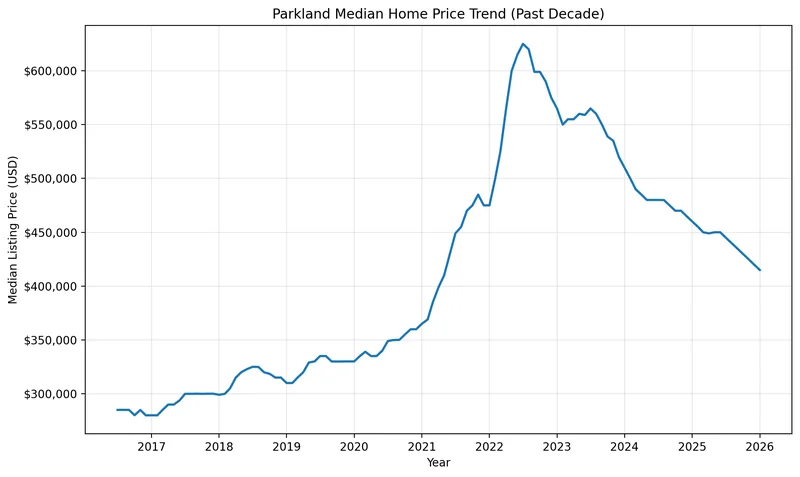
Chart of the Parkland median home price trend over the past decade, used for Broward County estate planning and Parkland Lady Bird Deed research
Parkland median home price trend (past decade)
On a home at this value, the cost of getting the structure wrong is measured in six figures.

Why a Minor on Title Is a Practical Problem

People sometimes hear the descent rule and conclude it is tolerable: the children end up owning the house, which is what the parent wanted anyway. The difficulty is not who owns it. It is what happens when someone needs to do something with it.

A minor can hold title to Florida real property. A minor cannot convey it. So if the surviving parent needs to sell the house, refinance it, or grant an easement, and a minor child holds an interest, that generally requires a court-appointed guardian of the property for the child and court approval of the transaction.

That is a proceeding, with its own costs, its own reporting obligations, and its own timeline, imposed on a surviving spouse in the year after a death, on the asset the family is most likely to need to move.

The natural guardian provision does not solve it

Parents are their children's natural guardians under Florida law, and there is a provision that lets them act without a court appointment. Its reach is narrow. Under Fla. Stat. § 744.301(2), natural guardians may collect, receive, manage and dispose of proceeds accruing to a minor child without appointment, authority, or bond, but only where the amounts received in the aggregate do not exceed $15,000.

Two things follow. First, that provision is about money reaching a child, from a settlement, an estate distribution, an insurance policy or a benefit plan. It is not a grant of authority over title to real estate. Second, on a Parkland home the figures are beyond it by two orders of magnitude in any event.

Add the ordinary complications. A vested remainder held by a child cannot be redirected later if circumstances change. A child who turns 18 owning a share of a house is a legal adult with a legal adult's rights, including the right to seek partition. And a surviving spouse holding a life estate carries the taxes, insurance and upkeep on a property they cannot sell without the remaindermen.

Sources: Fla. Stat. § 744.301(2) (natural guardians, $15,000 aggregate limit); Fla. Stat. ch. 744 (guardianship, including guardianship of the property of a minor and court approval of sales). Whether a guardianship is required in a particular transaction depends on the facts and on the title underwriter's requirements.

What to Do Instead

The restriction closes one door. It does not close the building. Here is what actually gets used, and why.

  1. A revocable trust holding the home

    A properly drafted trust can hold the residence, keep it out of probate, provide for the surviving spouse, and hold a child's share in trust until an age you choose rather than delivering it outright at 18. It also names someone to manage the property if you lose capacity, which no deed does. This is the workhorse answer for a family in Parkland's position, and the constitutional analysis of homestead held in trust is genuinely technical, which is a reason to have it drafted rather than assembled.

  2. Life insurance to equalize

    Where the house has to go one way for legal reasons, insurance proceeds can go the other way to balance it. Proceeds pass by beneficiary designation, outside probate, and reach the recipient quickly, which matters when a family needs liquidity in the first months.

  3. Direct the non-homestead assets deliberately

    The devise restriction reaches only the constitutional homestead. Accounts, retirement plans, investments, a second property and business interests are all outside it and can be directed where you want them.

  4. Look at how title is actually held

    Tenancy by the entireties between spouses passes the home to the survivor at the first death by operation of law, which changes the whole analysis. This costs nothing to check and is skipped constantly.

  5. Name a guardian for your children in your will

    Separate from all of the above, and the most important document a Parkland parent signs. A Lady Bird Deed cannot do it and neither can a trust.

  6. Diary the date your youngest turns 18

    The restriction lifts then. That is the date a Lady Bird Deed becomes available, and it is worth having in the calendar rather than discovered by accident.

None of this is exotic. It is ordinary planning that happens to be shaped by a constitutional provision most homeowners have never read.

Associations and Transfer Provisions

Nearly all of Parkland's residential development is planned and sits under a recorded declaration, frequently with a master association above the neighborhood one. The documents matter here.

A Lady Bird Deed is a present recorded conveyance, even though your beneficiaries receive nothing until you die. The association's transfer provisions can therefore be triggered by the recording itself. Before drafting, the documents deserve a read for:

  • Transfer approval or notice requirements when record title changes
  • Rights of first refusal, which appear in some declarations
  • Leasing restrictions, which constrain what a surviving family can do
  • Recorded assessments and liens, which follow the property
  • Architectural and use covenants that limit an heir's options

None of this stops a Lady Bird Deed. It is the difference between a deed drafted by someone who read your documents and one drafted from a form.

Parkland Lady Bird Deed lawyer reviewing homeowner association documents before drafting

Homestead Exemption, Save Our Homes and Spousal Rights

A properly drafted Parkland Lady Bird Deed should not disturb your homestead exemption or your Save Our Homes assessment cap during your lifetime. You retain the enhanced life estate, you remain in possession, and the Broward County Property Appraiser continues to treat you as the owner of record.

The cap does not pass to your beneficiaries. It resets on the change of ownership at death, the same as it would through probate or a trust.

It is worth separating the two homestead concepts, because they share a name and do entirely different work. The homestead exemption is a property tax benefit administered by the Property Appraiser. The constitutional homestead under Article X, Section 4 is a creditor protection and a restriction on transfer. It is the second one that produces the minor child rule, and it applies whether or not you ever filed for the tax exemption.

On the spousal side, a married owner cannot convey homestead without the spouse joining in the deed, whether or not the spouse appears on title. That routinely surprises people who bought the house before marrying. A married Parkland couple normally signs the Lady Bird Deed together.

Medicaid and Estate Recovery

Florida's Medicaid program is required by federal law to seek reimbursement from the estates of recipients aged 55 and over who received long-term care benefits. Everything turns on how estate is defined, and Florida defines it narrowly: recovery reaches assets passing through the probate estate. Florida has not adopted the expanded definition some states use.

Because a Lady Bird Deed moves the home outside probate, it is one of the standard tools for reducing estate recovery exposure on a Florida homestead. Recording it is not a transfer for the five-year look-back, because nothing leaves your control during your lifetime.

In Parkland this is usually a longer-horizon concern than elsewhere on this site, given the age profile. It tends to matter most for an aging parent living in the household rather than for the owners themselves, which is a conversation worth having while there is time to plan.

The limits

  • The deed does not qualify anyone for Medicaid. Eligibility is a separate analysis.
  • The five-year look-back applies to transfers of non-homestead assets.
  • Protection depends on the home keeping homestead status and passing to heirs; a will directing a sale undoes it.

Our full write-up is on the Florida Lady Bird Deed and Medicaid page.

Sources: 42 U.S.C. § 1396p; Fla. Stat. §§ 409.910 and 409.9101; Art. X, § 4, Fla. Const.

Recording a Parkland Lady Bird Deed

Here is the Broward quirk worth knowing: the Clerk of Courts does not record deeds in Broward County. That function belongs to the county's Records, Taxes & Treasury Division. Sending a deed to the Clerk, as you would in most other Florida counties, sends it to the wrong office.

The recording counter is at the Broward County Governmental Center, 115 South Andrews Avenue, Room 114, Fort Lauderdale, Florida 33301, generally open 8:30 a.m. to 5:00 p.m. weekdays. Deeds may also be mailed or submitted through an approved e-recording provider, which returns the recorded instrument in a day or two.

Execution requirements

Florida requires a deed conveying an interest in real property to be signed in the presence of two subscribing witnesses and acknowledged before a notary public (Fla. Stat. §§ 689.01 and 695.03). Both witnesses must be present and must sign.

Recording fees and documentary stamp tax

Recording charges are $10.00 for the first page, $8.50 for each additional page, and $1.00 per name indexed beyond four names. Broward applies the standard statewide documentary stamp rate of $0.70 per $100 of consideration on taxable deeds, unlike neighboring Miami-Dade.

Whether the tax applies to this deed at all was addressed in Technical Assistance Advisement 20B4-004 (October 16, 2020), in which the Florida Department of Revenue concluded that an enhanced life estate deed is not subject to documentary stamp tax, because no present beneficial interest transfers when the deed is signed. A Technical Assistance Advisement binds the Department only as to the taxpayer and facts presented. Where the property carries a mortgage, the analysis turns on whether there is consideration, and on a Parkland home with a substantial mortgage that question deserves attention.

Sources: Broward County Records, Taxes & Treasury Division, Recording; Florida Department of Revenue Technical Assistance Advisement 20B4-004 (Oct. 16, 2020); Fla. Stat. ch. 201; Fla. Stat. § 28.24(13) (statutory service charges); Fla. Stat. §§ 689.01, 695.03.

After a Death: What Your Family Actually Does

This assumes the deed operates, meaning no minor child survives you.

  1. Order certified death certificates

    From the Florida Department of Health. Order several: the property appraiser, the insurer, the association and any lender will each want one.

  2. Record one against the property

    Recorded in the Broward County Official Records, this publicly establishes that the life estate has ended and the named beneficiaries hold title.

  3. Provide an affidavit if a title company asks

    On a sale or refinance, a title underwriter commonly wants an affidavit confirming identity, continuous marital status, and that the deed was never revoked.

  4. Notify the insurer and the association

    Both need to know who owns and occupies the property.

  5. Decide together what happens to the house

    Multiple beneficiaries take undivided shares as tenants in common. Agreement is easier while everyone is still talking.

What is not on that list, for the house: a probate case, a personal representative, publication of notice to creditors, or a creditor claim period for that property.

What a Lady Bird Deed Does Not Do

Common misconceptions, including the one that defines this page.
People assume it…Reality
Works even if you have a minor childNo. The homestead cannot be devised while a minor child survives you, and the deed fails as to the homestead.
Lets you leave the house to a trust for the childrenNot while a minor child survives you. The restriction reaches the devise itself, whatever the destination.
Names a guardian for your childrenNo. That belongs in a will, and it is the more important document.
Covers the whole estateOnly the real property described in the deed. Accounts, retirement plans and belongings are untouched.
Replaces a willNo. You still want a will for everything the deed does not cover.
Overrides HOA documentsNo. Transfer approval, leasing limits and recorded assessments all still apply.
Passes your Save Our Homes cap to the kidsNo. It resets on the change of ownership at death.
Manages things if you lose capacityNo. That is what a durable power of attorney or a funded trust is for.

How a Parkland Lady Bird Deed Compares to the Alternatives

General comparison for a Florida homestead. The middle column is the one that matters for a young family.
OptionAvoids probate?Works with a minor child?Preserves stepped-up basis?Typical Parkland drawback
Lady Bird DeedYes, for that propertyNo, as to the homesteadYesFails silently at exactly the moment the family needs it.
Will onlyNoNo, the same restriction appliesYesGuarantees a Broward probate case, and the homestead still descends by statute.
Revocable living trustYes, if fundedNot for the homestead devise, but it holds a child's share properlyYesHigher cost, and homestead held in trust needs careful drafting.
Life insuranceYes, by designationYesNot applicableDoes not move the house, but it can balance who gets what.
Deed the home to the kids nowYesNo, and worseNoForfeits the basis step-up and puts a minor on title with no way to sell.
Adding a child as joint ownerPartiallyNoPartially lostCreates a present co-owner with veto power and creditor exposure.

Our fuller breakdown is on the Florida Lady Bird Deed comparison page. For what a deed does when a beneficiary dies before you, see the Plantation page.

How to Get a Parkland Lady Bird Deed

  1. Answer the minor child question first

    It determines whether a Lady Bird Deed on the residence will work at all, so it comes before anything else.

  2. Confirm how the property is titled

    Tenancy by the entireties changes the analysis. Pull the last recorded deed rather than relying on memory.

  3. Decide who should receive the property

    Name beneficiaries directly, and add contingent takers so the deed still works if someone dies before you.

  4. Pull the vesting deed and folio number

    The exact legal description from the Broward County Official Records, plus the folio from the Property Appraiser.

  5. Read the association documents

    Transfer approval, rights of first refusal, leasing restrictions and recorded assessments.

  6. Draft the enhanced life estate reservation

    Reserving your power to sell, convey, mortgage, lease and revoke without the beneficiaries' consent.

  7. Sign with two witnesses and a notary

    Both witnesses present and signing. A married owner's spouse joins the deed on homestead property.

  8. Record with Broward Records, Taxes & Treasury

    Not the Clerk of Courts. At 115 South Andrews Avenue, Room 114, or by e-recording.

START WITH A CONSULTATION

Plain-English Glossary

Enhanced life estate deedThe formal name for a Lady Bird Deed. You keep a life estate plus the power to sell, mortgage or revoke without anyone's consent.
DeviseTo leave property to someone at your death by a document you signed. What the constitution prevents for homestead where a minor child survives you.
Constitutional homesteadThe creditor protection and transfer restriction in Article X, Section 4. Different from the property tax exemption of the same name.
DescentHow property passes when it is not effectively devised. For homestead, governed by Fla. Stat. § 732.401.
Life estateThe right to use and occupy property for the rest of your life. What a surviving spouse takes by default under the descent statute.
Vested remainderAn interest that is already owned now, taking possession later. What descendants hold while a surviving spouse holds the life estate.
Per stirpesBy branch of the family. If a child dies before you, their share passes down to their own children rather than across to their siblings.
Tenants by the entiretiesCo-ownership available only to spouses, carrying an automatic right of survivorship at the first death.
Natural guardianA parent, acting for a minor child. Authority over a child's money is capped at $15,000 in the aggregate without a court appointment.
Guardian of the propertyA court-appointed fiduciary who manages a minor's assets, required before a minor's interest in real property can be sold.
Stepped-up basisThe reset of cost basis to date-of-death value, which can eliminate accumulated capital gain on a later sale.

Parkland Communities We Serve

We prepare Lady Bird Deeds for property throughout Parkland and Broward County, including:

  • Heron Bay
  • Parkland Golf & Country Club
  • Parkland Isles
  • Parkland Bay
  • MiraLago
  • Cascata
  • Watercrest
  • Ternbridge
  • Mayfair
  • Cypress Cay
  • Pine Tree Estates
  • Ranches of Parkland
  • The Landings
  • Terramar
  • Sabal Chase
  • Meadow Run
  • Riverside
  • BBC Riverbend
  • Coral Springs border
  • Heron Bay North

Work With a Parkland Lady Bird Deed Attorney

Yanitza Schoonover focuses her practice on probate administration and estate planning for Florida families. She helps Parkland homeowners with:

  • Parkland Lady Bird Deed drafting, execution and recording
  • Planning around Florida's homestead devise restriction
  • Formal and summary probate administration
  • Estate planning for families with young children


If you have children under 18, the honest first question is not which deed to sign. It is whether a deed is the right instrument at all right now. Schedule a consultation and we will tell you plainly, and set out what does work in the meantime.

Schedule Your Consultation
Parkland Lady Bird Deed attorney Yanitza Schoonover

Yanitza Schoonover

Parkland Lady Bird Deed Frequently Asked Questions

I have young children. Can I put a Lady Bird Deed on my Parkland house?

If you have a child under 18, Florida's constitution does not permit you to devise your homestead, and a Lady Bird Deed naming anyone other than that child generally fails as to the homestead. This surprises almost everyone, because it is a restriction on what you may do with your own house. It is tested at your death, not at signing, so a deed recorded today can look perfectly valid for fifteen years and then not work. This does not mean nothing can be done. It means the plan is built around the restriction rather than ignoring it.

Why does Florida stop me leaving my house to whoever I want?

The restriction comes from Article X, Section 4 of the Florida Constitution, and its purpose is protective rather than punitive. Florida homestead law exists to keep families housed, and part of that scheme prevents an owner directing the home away from a surviving spouse or a minor child. The same body of law gives your homestead very strong protection from creditors. The protection and the restriction are two sides of the same provision, and you do not get to keep one without the other.

So what happens to the house if I die with a minor child?

It descends under Fla. Stat. § 732.401. If you are survived by a spouse and one or more descendants, the surviving spouse takes a life estate in the homestead with a vested remainder to your descendants living at your death, per stirpes. In place of the life estate, the surviving spouse may elect to take an undivided one-half interest as a tenant in common, with the other half vesting in those descendants. That election must be made within six months after death and during the surviving spouse's lifetime, so it is a real deadline rather than a formality.

What is wrong with my child owning a share of the house?

A minor can hold title, but a minor cannot convey it. If the surviving parent needs to sell the home or refinance it, and a minor child holds an interest, that generally requires a court-appointed guardian of the property for the child and court approval of the transaction. It is a proceeding, with costs and reporting obligations, on the very asset a family often needs to move quickly after a death. That is the practical harm, and it lands on the surviving spouse at the worst possible time.

Can I just have the surviving parent handle it as natural guardian?

Only within narrow limits. Under Fla. Stat. § 744.301(2), natural guardians may collect, receive, manage and dispose of certain proceeds accruing to their minor children without a court appointment, but only where the amounts received in the aggregate do not exceed $15,000. That provision is about money reaching a child, not about title to real estate, and it does not give a parent authority to sign away a minor's interest in a house. On a Parkland home the figures involved are far beyond it in any event.

What should we do instead?

Usually a trust does the work the deed cannot. A properly drafted revocable trust can hold the home, keep it out of probate, provide for the surviving spouse, and hold a child's share in trust until an age you choose rather than handing it to them at 18. Life insurance can equalize between children without forcing a sale. Non-homestead assets can be directed where you want them, because the devise restriction reaches only the constitutional homestead. And the restriction ends when your youngest child turns 18, at which point a Lady Bird Deed becomes available.

Does the restriction apply if my spouse and I own the house together?

Property held by a married couple as tenants by the entireties, which is the usual arrangement for Florida married homeowners, passes automatically to the surviving spouse at the first death by operation of law. Fla. Stat. § 732.401 states that it does not apply to property held in tenancy by the entireties or in joint tenancy with rights of survivorship. So the descent rules generally arrive at the second death rather than the first. That is a reason to look closely at how title is actually held rather than assuming.

Where is a Lady Bird Deed recorded for Parkland property?

In the Broward County Official Records. Broward is unusual in that deeds are recorded by the county Records, Taxes & Treasury Division rather than the Clerk of the Circuit Court. The counter is at the Broward County Governmental Center, 115 South Andrews Avenue, Room 114, Fort Lauderdale, generally open 8:30 a.m. to 5:00 p.m. weekdays. Deeds may also be mailed or submitted through an approved e-recording provider.

Will a Parkland Lady Bird Deed affect my homestead exemption?

A properly drafted deed should not affect your homestead exemption or your Save Our Homes assessment cap during your lifetime. You retain an enhanced life estate, you remain in possession, and the Broward County Property Appraiser continues to treat you as the owner of record. The cap resets at your death on the change of ownership, which happens with or without the deed.

Do my beneficiaries get a stepped-up basis?

Generally yes. Because you keep the enhanced powers, the property remains in your gross estate at death, which normally produces a stepped-up cost basis, meaning their basis becomes the date-of-death value rather than what you paid. On a Parkland home this is often the single most valuable feature of the deed. Deeding the home to a child during your lifetime typically forfeits it. Confirm the treatment with a tax advisor.

Can a Parkland Lady Bird Deed be changed or revoked later?

Yes. You can sell the property, refinance it, lease it, add or remove beneficiaries, or revoke the deed entirely without the consent of the people named to receive it. A new deed is prepared and recorded to make the change effective. For a young family that flexibility matters, because the people you would name today are unlikely to be the arrangement you want twenty years from now.

More general questions are answered on our Florida Lady Bird Deed FAQ page.

We also assist homeowners in nearby Broward markets including Coral Springs, Pompano Beach, Deerfield Beach, Sunrise, Plantation, Weston, and Fort Lauderdale. Browse every market on our areas we serve page.

Florida Lady Bird Deed Attorney Serves Homeowners Across Florida

We help homeowners throughout Florida with Lady Bird Deeds and probate avoidance planning. Below are many of the primary Florida markets we serve, but we're not limited to these locations. You can also browse the full Florida Lady Bird Deed city and county directory.

Boca RatonBoynton BeachCape CoralClearwaterCoral SpringsDavieDaytona BeachDeerfield BeachDoralFort LauderdaleHallandale BeachHialeahHollywoodHomesteadJacksonvilleKendallLauderdale LakesMiamiMiami BeachMiramarOrlandoParklandPembroke PinesPine HillsPlantationPompano BeachPort Saint LucieSaint PetersburgSunriseTallahasseeTampaWest Palm BeachWeston

Legal disclaimer. This page is general information about Florida law, not legal advice, and reading it does not create an attorney-client relationship. Whether particular property qualifies as constitutional homestead, and how it descends, are determined on the facts at the owner's death. Recording locations, fees, tax rates and court procedures described were accurate as of August 2026 and should be confirmed with Broward County Records, Taxes & Treasury and the Florida Department of Revenue.

The Schoonover Law Firm, P.A. · Yanitza Schoonover, Attorney at Law · Licensed in Florida. Attorney advertising.