Daytona Beach Lady Bird Deed Attorney

A Daytona Beach Lady Bird Deed, known formally as a Florida enhanced life estate deed, lets your home or condominium pass directly to the beneficiaries you name at your death, with no Volusia County probate case on that property. Nothing changes while you are alive: you stay on title, you keep your homestead exemption, and you can live in the property, rent it, refinance it, sell it or revoke the deed.

Daytona Beach is an older, more modest market than most of the Florida coast. 22.5% of residents are 65 or older, 47.5% of housing is owner-occupied, the median owner-occupied home is worth $287,700, and median household income is $52,058.

Put those numbers together and you get a specific kind of client: someone in their seventies or eighties, in a house worth a good deal more than they paid for it, on an income that has to stretch to cover taxes, insurance and a roof. Sooner or later a question arrives that has nothing to do with probate. Do I sell this house, or hold on to it and leave it to my family? There are two genuinely good tax answers, and they are mutually exclusive. This page is about both, and about the feature of the deed that keeps both doors open.

Daytona Beach Lady Bird Deed: the short version

  • What it does: names beneficiaries who receive the property automatically at death, outside of probate.
  • What you keep: full control for life, with the freedom to sell, rent, refinance or revoke without anyone's permission.
  • Sell during life: the § 121 exclusion may cover the gain, generally up to $250,000, or $500,000 filing jointly.
  • Pass it at death: your beneficiaries generally take a stepped-up basis at date-of-death value.
  • The deed does not pick for you. The enhanced reservation lets you decide later instead of now.
  • Where it records: the Clerk of the Circuit Court, Volusia County, serving DeLand and Daytona Beach.

What Is a Daytona Beach Lady Bird Deed?

A Daytona Beach Lady Bird Deed is the common name for a Florida enhanced life estate deed recorded on property in Volusia County. It names the beneficiaries, called remaindermen, who receive the property automatically at your death, while reserving to you an enhanced life estate that leaves you in control for life.

The word enhanced is not decoration. Under a traditional life estate deed the beneficiaries hold a present vested interest from the day it is signed, and you could not sell without every one of them signing. For an eighty-year-old who might need assisted living next spring, that is a trap.

An enhanced life estate deed instead reserves to you the power to sell, convey, mortgage, lease and revoke without the consent of the remainder beneficiaries. They get nothing until you die still owning the property. If you sell, their interest evaporates, with no say and no claim on the proceeds. In a city where more than one in five residents is past sixty-five, that is the most valuable thing an estate planning instrument can do.

The recording formalities come from Fla. Stat. §§ 689.01 and 695.03. The enhanced reservation itself is a creature of Florida practice and title custom rather than a statute written for it, which is why the drafting matters. For a broader comparison, see our guide to Lady Bird Deeds versus wills, trusts and quitclaim deeds.

Daytona Beach Lady Bird Deed attorney helping Volusia County homeowners avoid probate

Sell During Life, or Pass It at Death?

Most estate planning pages assume you are keeping the house. In this market that is wrong often enough to be worth confronting. Many Daytona Beach owners reach a point where the house stops being an asset and starts being a job: the insurance renewal, the roof, the stairs, the distance from family. Selling then is not a failure of planning. Run both branches.

Branch one: you sell while you are alive

Internal Revenue Code § 121 allows an individual to exclude gain on the sale of a principal residence, generally up to $250,000, or up to $500,000 for a married couple filing jointly, subject to an ownership and use test of at least two of the five years before the sale.

For an owner who bought here in the 1980s or 1990s and never left, that exclusion is frequently large enough to swallow the entire gain, because appreciation on a home in this price range is rarely a quarter of a million dollars, let alone half a million. The practical result is often a sale producing cash and no federal income tax on the profit. That outcome is available only while you are alive and living there. Your children cannot use it after your death.

Branch two: you die owning the property

If instead you die owning the property, it remains in your gross estate, and the beneficiaries generally receive a stepped-up cost basis equal to the date-of-death value. Thirty years of accumulated gain is not taxed to them, and if they sell shortly afterwards there is typically very little left to report. That is also an excellent outcome, and it is available only if you did not take branch one.

Why this is a real fork and not a hypothetical

  • Sell now: the § 121 exclusion may erase the gain, but the proceeds become cash in your estate. Cash is a probate asset, and probate assets are what Medicaid estate recovery reaches.
  • Hold and pass it: the heirs get a stepped-up basis and the home passes outside probate, but you keep carrying the house on a fixed income.
  • Neither answer is wrong. The right one depends on your health, your family, and how the next few years go.
  • You do not have to answer today. That is the whole argument for the enhanced life estate deed.

What the deed contributes

Recording a Lady Bird Deed does not commit you to branch two. The enhanced reservation means you can sell at any time, without asking your beneficiaries and without their signatures on anything. The deed sits in the Official Records doing nothing until it is needed, and if that moment never comes because you sold the house, no harm is done.

Under a traditional life estate deed the choice would effectively be made the day you signed, because a sale would require all of your children to join in. If one lived out of state and one did not want the house sold, you would be negotiating your own move from a position of weakness. That is why the enhanced part matters more to this population than to almost anyone else on this site.

Sources: Internal Revenue Code §§ 121 and 1014. Eligibility for the exclusion depends on ownership and use and on individual circumstances. Confirm the treatment of any particular sale with a qualified tax advisor.

Daytona Beach Estate Planning Snapshot

An older, moderate-income coastal market with a large renter share and many owners who bought long ago.

  • 22.5% of Daytona Beach residents are age 65+
  • 47.5% of housing units are owner-occupied
  • $287,700 median value of owner-occupied housing
  • $52,058 median household income
  • 9.5% of residents are foreign-born
  • 12.4% speak a language other than English at home

22.5% aged 65 or older is one of the highest figures on this site, and it changes the emphasis of everything below. Medicaid estate recovery, execution formalities at a care facility, and the sale-or-hold decision are not footnotes here. They are the reason people call.

At 47.5% owner-occupied, fewer than half the housing units in the city are lived in by their owners, and many of those owners own outright.

The combination of a $287,700 median home value and a $52,058 median household income is the heart of the matter. For a retired owner that is a large amount of wealth locked in an illiquid asset that costs real money every month to keep. It is why the sale question comes up here more than in higher-income markets.

At 9.5% foreign-born and 12.4% speaking a language other than English at home, this is not a market defined by cross-border complexity. The issues are generational: long tenure, adult children living elsewhere, and deeds nobody has looked at in decades.

Demographic figures: U.S. Census Bureau QuickFacts, Daytona Beach city, Florida (most recent American Community Survey five-year estimates available at publication).

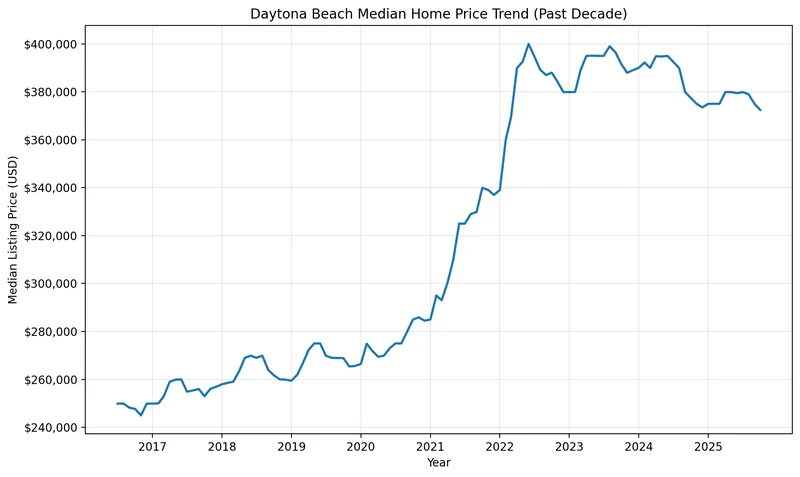
Chart of the Daytona Beach median home price trend over the past decade, used for Volusia County estate planning and Daytona Beach Lady Bird Deed research
Daytona Beach median home price trend (past decade)
The steeper this line, the larger the gain a sale would realize, and the more the § 121 exclusion is doing for you.

The Two Outcomes Side by Side

It helps to see the branches in one view, because in conversation people hear only whichever was described last.

Two paths, two different federal tax mechanisms, both favorable.
 You sell during your lifetimeYou die owning the property
Which rule applies?Internal Revenue Code § 121Stepped-up basis under § 1014
Who gets the benefit?YouYour beneficiaries
What it doesExcludes gain, generally up to $250,000, or $500,000 filing jointlyResets basis to date-of-death value
ConditionsOwnership and use test of at least two of the five years before the saleThe property must remain in your gross estate, so it must not have been given away
What you end up holdingCash, which is a probate assetA house that passes outside probate under the deed
Ongoing cost to youNone. The house is gone.You keep paying taxes, insurance and maintenance
Does the deed force this?NoNo

Read the bottom rows together, because that is where the real trade sits. Selling ends the carrying cost, no small thing on a $52,058 median household income, but it converts the home into money that lands in the probate estate. Holding keeps the probate avoidance and the stepped-up basis, but you keep paying for the roof. Neither outcome is dictated by the deed, and that neutrality is the point.

How we talk this through with clients

  • Record the deed now. It does not restrict you, and it solves the probate problem if you never sell.
  • Do not sell for tax reasons alone. The § 121 exclusion is a reason the sale will not be punished, not a reason to sell.
  • Do not hold for tax reasons alone either. A stepped-up basis is not worth five extra years in an unsuitable house.
  • If you do sell, come back. The proceeds need a plan of their own.
  • Never deed the house to your children to sidestep the question. That forfeits the step-up, forfeits your exclusion, and ends your control.

Some owners assume that if they might sell, there is no point recording a deed at all. That gets it backwards. A deed that goes unused because you sold cost you a recording fee. A probate that happens because you never got around to it costs a great deal more.

What Changes the Day You Actually Sell

It would be dishonest to sell the deed's flexibility without explaining what happens when you use it. A sale changes what the plan is made of.

A deed passes real property. It does not pass money. The moment the closing funds land in your account, the asset the deed described no longer exists, and the beneficiaries named in it would receive nothing. What you hold instead is cash, a certificate of deposit, a brokerage account, or a smaller condominium bought with the proceeds. Each needs its own answer:

  • Bank and brokerage accounts can often be handled with beneficiary designations, so they pass outside probate as the house did.
  • A replacement home in Florida can take a new Lady Bird Deed of its own, the ordinary course when someone downsizes within Volusia County.
  • A move out of state takes the property outside Florida law, and the new state's rules govern. Many states do not recognize this deed at all.
  • Cash left sitting in your name with no designation is a probate asset, full stop.

That connects back to Medicaid. Florida limits estate recovery to the probate estate, which is why the deed works so well on a homestead. Proceeds sitting in a plain account land inside that estate, the one place the deed was designed to keep the home out of.

None of this argues against selling. It argues for treating a sale as a planning event. The conversation afterwards is short, usually a few beneficiary designation forms and, if you bought again in Florida, a new deed on the new place.

Homestead Exemption, Save Our Homes and Spousal Rights

A properly drafted Daytona Beach Lady Bird Deed should not disturb your homestead exemption or your Save Our Homes assessment cap during your lifetime. You retain the enhanced life estate, you remain in possession, and the Property Appraiser continues to treat you as the owner of record.

Separate the two homestead concepts, which share a name and do different work. The homestead exemption is a property tax benefit administered by the Property Appraiser, and it is what the Save Our Homes assessment limitation attaches to. The constitutional homestead under Article X, Section 4 of the Florida Constitution is a creditor protection and a transfer restriction, and it applies whether or not you filed for the tax exemption.

A married owner cannot convey homestead without the spouse joining in the deed, whether or not the spouse appears on title, and homestead cannot be devised away from a surviving spouse or a minor child. These restrictions are tested at death rather than at signing, which is why a deed that looked fine for years can fail at the moment it is needed. Where owners are widowed or remarried later in life, this is one of the most common places a do-it-yourself deed goes wrong.

On the property tax side, Save Our Homes resets on the change of ownership at death, whether the home passes by deed, through probate, or out of a trust. Say so in advance, because the first full-year tax bill after a death is a predictable source of alarm.

Medicaid and Estate Recovery

Florida's Medicaid program is required by federal law to seek reimbursement from the estates of recipients aged 55 and over who received long-term care benefits, and the word doing all the work is estate. Florida defines it narrowly: recovery reaches assets passing through the probate estate, and Florida has not adopted the expanded definition some states use.

Because a Lady Bird Deed moves the home outside probate, it is a standard tool for reducing estate recovery exposure on a Florida homestead. Recording it is not a transfer for the five-year look-back, because nothing leaves your control during your lifetime.

With 22.5% of residents aged 65 or older, this connects directly to the sale-or-hold question above. An owner contemplating assisted living is often contemplating long-term care at the same time. The house and the care decision arrive together.

The limits

  • The deed does not qualify anyone for Medicaid. Eligibility is a separate analysis.
  • The five-year look-back applies to transfers of non-homestead assets.
  • Protection depends on the home keeping homestead status and passing to heirs; a will directing a sale undoes it.
  • Sale proceeds are not the home. Converting the house to cash moves the value into the probate estate unless the proceeds are addressed separately.

Our full write-up is on the Florida Lady Bird Deed and Medicaid page.

Sources: 42 U.S.C. § 1396p; Fla. Stat. §§ 409.910 and 409.9101; Art. X, § 4, Fla. Const.

Recording a Daytona Beach Lady Bird Deed

Deeds in Volusia County are recorded by the Clerk of the Circuit Court, Volusia County, in the county's Official Records. The office serves locations in DeLand and Daytona Beach, and the mailing address is P.O. Box 6043, DeLand, Florida 32721-6043. Counter locations and public hours change, so confirm the current counter locations and hours with the Clerk before traveling with a document to record.

If you are following instructions written for somewhere else in Florida, know that the recording office is not the same from county to county. Volusia records through the Clerk of the Circuit Court, Broward uses its Records, Taxes & Treasury Division, and Orange County uses the County Comptroller. Those offices are not interchangeable, and directions borrowed from another county are a common reason a document comes back.

Execution requirements

Florida requires a deed conveying an interest in real property to be signed in the presence of two subscribing witnesses and acknowledged before a notary public (Fla. Stat. §§ 689.01 and 695.03). Both witnesses must be present and must sign. Deeds signed at a hospital or care facility without proper witnessing fail this test regularly, and the failure surfaces at death when it can no longer be corrected. In a market with this age profile that is a recurring risk, and a hurried deed that fails is worse than no deed at all, because the family relies on it.

Recording fees and documentary stamp tax

Recording charges are $10.00 for the first page, $8.50 for each additional page, and $1.00 per name indexed beyond four names. Volusia applies the standard statewide documentary stamp rate of $0.70 per $100 of consideration on taxable deeds.

Whether the tax applies to this deed at all was addressed in Technical Assistance Advisement 20B4-004 (October 16, 2020), in which the Florida Department of Revenue concluded that an enhanced life estate deed is not subject to documentary stamp tax, because no present beneficial interest transfers when the deed is signed. A Technical Assistance Advisement binds the Department only as to the taxpayer and facts presented, and where the property carries a mortgage the analysis turns on whether there is consideration.

Sources: Clerk of the Circuit Court, Volusia County, Official Records and Recording (DeLand and Daytona Beach; mailing address P.O. Box 6043, DeLand, Florida 32721-6043); Florida Department of Revenue Technical Assistance Advisement 20B4-004 (Oct. 16, 2020); Fla. Stat. §§ 689.01, 695.03. Confirm current locations, hours and charges with the Clerk.

After a Death: What Your Family Actually Does

  1. Order certified death certificates

    From the Florida Department of Health. Order several: the Property Appraiser, the insurer and any association will each want one.

  2. Record one against the property

    Recorded in the Volusia County Official Records, this publicly establishes that the life estate has ended and the named beneficiaries hold title.

  3. Provide an affidavit if a title company asks

    A title underwriter commonly wants an affidavit confirming identity, marital status, and that the deed was never revoked.

  4. Establish the date-of-death value

    The beneficiaries' basis resets to that figure, so document it then rather than reconstructing it years later.

  5. Expect the property tax bill to change

    Save Our Homes resets on the change of ownership at death, whether or not there was a deed.

  6. Apply for their own homestead exemption

    A beneficiary who moves in applies in their own name with the Property Appraiser, for the year they qualify.

  7. Notify the insurer and any association

    A lapse in coverage during the handover is a real risk.

What is not on that list: a petition, a filing fee, a personal representative, publication of notice to creditors, or a creditor claim period.

If other assets do require a probate case, Florida's summary administration under Fla. Stat. § 735.201 may be available. The non-exempt asset ceiling was raised to $150,000 effective July 1, 2026 by CS/SB 1500, for deaths on or after that date. Keeping the house out of the probate estate is often what keeps the rest of the estate under that ceiling.

What a Lady Bird Deed Does Not Do

Common misconceptions, several of them about what happens if you sell.
People assume it…Reality
Locks you into keeping the houseNo. You can sell at any time without asking your beneficiaries.
Covers the money if you sellNo. Sale proceeds need beneficiary designations or another instrument.
Gives your children the § 121 exclusionNo. That exclusion belongs to an owner who lived in the home. It is not inheritable.
Passes your Save Our Homes cap to the kidsNo. It resets on the change of ownership at death. No instrument prevents that.
Covers the whole estateOnly the real property described in it. Accounts and belongings are untouched.
Overrides condominium or HOA documentsNo. Transfer approval, leasing limits and recorded assessments all still apply.
Qualifies you for MedicaidNo. It may reduce estate recovery exposure, but it does not create eligibility.
Stops your children arguingNo. It hands them undivided shares, and any one of them can generally seek partition.

The second and third rows are specific to this page. An owner who sells and assumes the deed still has everything covered is the most avoidable failure in this plan.

How a Daytona Beach Lady Bird Deed Compares to the Alternatives

General comparison for a Florida homestead, weighted toward whether you can still sell.
OptionAvoids probate?Can you still sell alone?Preserves stepped-up basis?Typical drawback here
Lady Bird DeedYes, for that propertyYesYesCovers only the property described in it.
Will onlyNoYesYesGuarantees a Volusia probate case on the house.
Revocable living trustYes, if fundedYes, as trusteeYesBetter where you want to direct a sale and divide proceeds.
Deed the home to the kids nowYesNo. It is not your house.NoForfeits the step-up, forfeits your exclusion, ends your control.
Adding a child as joint ownerPartiallyNo. They must sign.Partially lostCreates a present co-owner with veto power and creditor exposure.
Traditional life estate deedYesNo. Every beneficiary must join.YesThe sale decision is made the day you sign.

Read the middle column top to bottom. Three of these six options quietly take the sale decision away from you, and two do it while also costing your family the stepped-up basis. For an owner in their late seventies, giving up the ability to sell alone is a much bigger concession than it sounds at the kitchen table.

The revocable trust deserves a fair mention, because it also keeps the sale power in your hands and handles the proceeds problem the deed does not. Our fuller breakdown is on the comparison page.

How to Get a Daytona Beach Lady Bird Deed

  1. Work out what a sale would produce

    What you paid, what you put in, and what it is worth now. That is the gain, and it tells you how much of the § 121 exclusion you would need. Confirm with a tax advisor.

  2. Decide whether you need to decide today

    Usually not. The deed keeps both branches open while you see how the next few years go.

  3. Confirm the deed fits your goals

    How the property is titled, who you want to receive it, whether you are married, and whether there is a minor child.

  4. Pull the vesting deed and parcel number

    The exact legal description from the Volusia County Official Records, plus the parcel identification number.

  5. Draft the enhanced life estate reservation

    Reserving your power to sell, mortgage, lease and revoke without the beneficiaries' consent, and naming contingent takers.

  6. Sign with two witnesses and a notary

    Both witnesses present and signing. A married owner's spouse joins the deed on homestead property.

  7. Record with the Volusia County Clerk

    In the county's Official Records. Confirm current counter locations and hours before traveling.

  8. Revisit the plan if you ever sell

    The proceeds are not covered by the deed. That is the conversation people forget.

START WITH A CONSULTATION

Plain-English Glossary

Enhanced life estate deedThe formal name for a Lady Bird Deed. You keep a life estate plus the power to sell, mortgage or revoke without anyone's consent.
RemaindermanA person named in the deed to receive the property at your death. No present interest while you are alive.
Stepped-up basisThe reset of cost basis to date-of-death value, available because the property remains in your gross estate.
Gross estateThe federal tax concept of everything you owned at death. Property must be in it for the basis step-up to apply.
§ 121 exclusionThe principal residence gain exclusion, generally up to $250,000, or $500,000 for a married couple filing jointly, subject to an ownership and use test.
Probate estateAssets passing under a will or by intestacy through a court case. What Medicaid estate recovery reaches.
Save Our HomesThe assessment limitation holding down the taxable value of a Florida homestead. It resets at death.
Constitutional homesteadThe creditor shield and transfer restriction in Article X, Section 4. Different from the tax exemption of the same name.
Summary administrationThe shortened Florida probate procedure under Fla. Stat. § 735.201, with a non-exempt asset ceiling of $150,000 for deaths on or after July 1, 2026.

Daytona Beach Neighborhoods We Serve

We prepare Lady Bird Deeds for property throughout Daytona Beach and Volusia County, including:

  • Beachside
  • Seabreeze
  • South Peninsula
  • Riverfront
  • Daytona Beach Shores
  • LPGA
  • Indigo
  • Pelican Bay
  • Midtown
  • Ortona
  • Bellair
  • Derbyshire
  • Sunrise Park
  • Halifax
  • Nova Road corridor
  • Daytona Highridge
  • Wilbur-by-the-Sea
  • Ormond Beach border
  • Holly Hill border
  • Port Orange border

Work With a Daytona Beach Lady Bird Deed Attorney

Yanitza Schoonover focuses her practice on probate administration and estate planning for Florida families. She helps Daytona Beach homeowners with:

  • Daytona Beach Lady Bird Deed drafting, execution and recording
  • Planning for owners weighing a sale against holding the home
  • Formal and summary probate administration
  • Estate planning coordination for Florida homesteads


If you are not sure whether you will still want this house in five years, that is not a reason to put off planning. It is the reason to use an instrument that does not make you decide today.

Schedule Your Consultation
Daytona Beach Lady Bird Deed attorney Yanitza Schoonover

Yanitza Schoonover

Daytona Beach Lady Bird Deed Frequently Asked Questions

Should I sell the house now or keep it for my children?

There is no single right answer. If you sell during your lifetime, Internal Revenue Code § 121 generally allows an individual to exclude up to $250,000 of gain on the sale of a principal residence, or up to $500,000 for a married couple filing jointly, subject to an ownership and use test of at least two of the five years before the sale. If instead you die owning the property, it remains in your gross estate and your beneficiaries generally receive a stepped-up cost basis equal to the date-of-death value. Both outcomes are good, and which is better depends on facts you may not know yet. The deed lets you defer the choice. Confirm the treatment of any sale with a qualified tax advisor.

What is the Section 121 exclusion in plain terms?

It is the rule that lets most people sell the home they live in without tax on the profit. Internal Revenue Code § 121 generally allows an individual to exclude up to $250,000 of gain on the sale of a principal residence, and up to $500,000 for a married couple filing jointly, subject to an ownership and use test of at least two of the five years before the sale. For an owner who bought decades ago it is often large enough to cover the entire gain. Eligibility depends on individual circumstances, so confirm your sale with a qualified tax advisor.

If I do not sell, what do my heirs get instead?

A stepped-up cost basis. Because the property stays in your gross estate when you die owning it, your beneficiaries' basis generally resets to the date-of-death value rather than what you originally paid. If they sell soon afterwards, there is little or no gain left to tax. The deed preserves that result because you never gave the property away during your lifetime, which is the difference between this deed and signing the house over to your children now.

Does a Lady Bird Deed stop me from selling the house later?

No, and for this population that is the most important feature. The reservation keeps the power to sell, convey, mortgage, lease and revoke in your hands alone, without your beneficiaries' signatures, agreement or knowledge. Under a traditional life estate deed you would need every one of them to sign, turning a move into assisted living into a family negotiation at the worst possible time.

What happens to the money if I do sell?

It becomes an ordinary asset in your name, and this is the honest limitation of the plan. A deed passes real property, not cash. Proceeds sitting in a bank or brokerage account at your death are generally a probate asset unless something else is done with them, and probate assets are what Florida Medicaid estate recovery reaches. A sale does not break the deed, but it changes what the plan needs to cover.

Where is a Lady Bird Deed recorded in Volusia County?

With the Clerk of the Circuit Court, Volusia County, in the county's Official Records. The office serves DeLand and Daytona Beach, and the mailing address is P.O. Box 6043, DeLand, Florida 32721-6043. Counter locations and hours change, so confirm current arrangements with the Clerk before traveling. The recording office differs by county: Broward uses its Records, Taxes & Treasury Division and Orange County uses the County Comptroller, so instructions written for another county are not interchangeable.

Does a Daytona Beach Lady Bird Deed protect the home from Medicaid estate recovery?

Florida limits Medicaid estate recovery to assets passing through the probate estate, and has not adopted the expanded definition some states use. Because the deed moves the home outside probate, it is a standard tool for reducing exposure on a Florida homestead. With 22.5% of Daytona Beach residents aged 65 or older, this is a live question for a large share of owners here. The deed does not qualify anyone for Medicaid, and protection depends on the home keeping homestead status and passing to heirs. See our Medicaid guide.

Does the deed change my homestead exemption or my property taxes now?

A properly drafted deed should not affect either during your lifetime. You retain an enhanced life estate, remain in possession, and the Property Appraiser continues to treat you as the owner of record, so the exemption and the Save Our Homes benefit continue as before. What does change is what happens at your death: Save Our Homes resets on the change of ownership, whether the home passes by deed, through probate, or out of a trust.

Can I use a Lady Bird Deed on a condominium?

Yes, which matters in a market with this much beachside condominium stock. What differs is the governance: the declaration controls transfer approval, leasing and assessments, and those obligations follow the unit to your beneficiaries. For units in older buildings of three habitable stories or more, milestone inspection and structural reserve obligations should be on the radar, and our Hallandale Beach page covers what that means for an heir.

What if I am married, or I have a minor child?

Then the constitutional homestead rules in Article X, Section 4 of the Florida Constitution govern. A married owner cannot convey homestead without the spouse joining in the deed, whether or not the spouse appears on title, and homestead cannot be devised away from a surviving spouse or a minor child. These restrictions are tested at death rather than at signing.

Can a Daytona Beach Lady Bird Deed be changed or revoked later?

Yes. You can sell, refinance, lease, add or remove beneficiaries, or revoke the deed entirely without the consent of the people named to receive it. A new deed is prepared and recorded to make the change effective. That flexibility is what makes recording one now compatible with selling later.

More general questions are answered on our Florida Lady Bird Deed FAQ page.

We also assist homeowners across Florida including Orlando, Jacksonville, Saint Petersburg, Tampa, Port St. Lucie, and West Palm Beach. Browse every market on our areas we serve page.

Florida Lady Bird Deed Attorney Serves Homeowners Across Florida

We help homeowners throughout Florida with Lady Bird Deeds and probate avoidance planning. Below are many of the primary Florida markets we serve, but we're not limited to these locations. You can also browse the full Florida Lady Bird Deed city and county directory.

Boca RatonBoynton BeachCape CoralClearwaterCoral SpringsDavieDaytona BeachDeerfield BeachDoralFort LauderdaleHallandale BeachHialeahHollywoodHomesteadJacksonvilleKendallLauderdale LakesMiamiMiami BeachMiramarOrlandoParklandPembroke PinesPine HillsPlantationPompano BeachPort Saint LucieSaint PetersburgSunriseTallahasseeTampaWest Palm BeachWeston

Legal disclaimer. This page is general information about Florida law, not legal advice, and reading it does not create an attorney-client relationship. Federal tax outcomes described here depend on individual circumstances and should be confirmed with a qualified tax advisor. Recording locations, fees, tax rates and court procedures described were accurate as of August 2026 and should be confirmed with the Clerk of the Circuit Court, Volusia County, the Volusia County Property Appraiser and the Florida Department of Revenue.

The Schoonover Law Firm, P.A. · Yanitza Schoonover, Attorney at Law · Licensed in Florida. Attorney advertising.